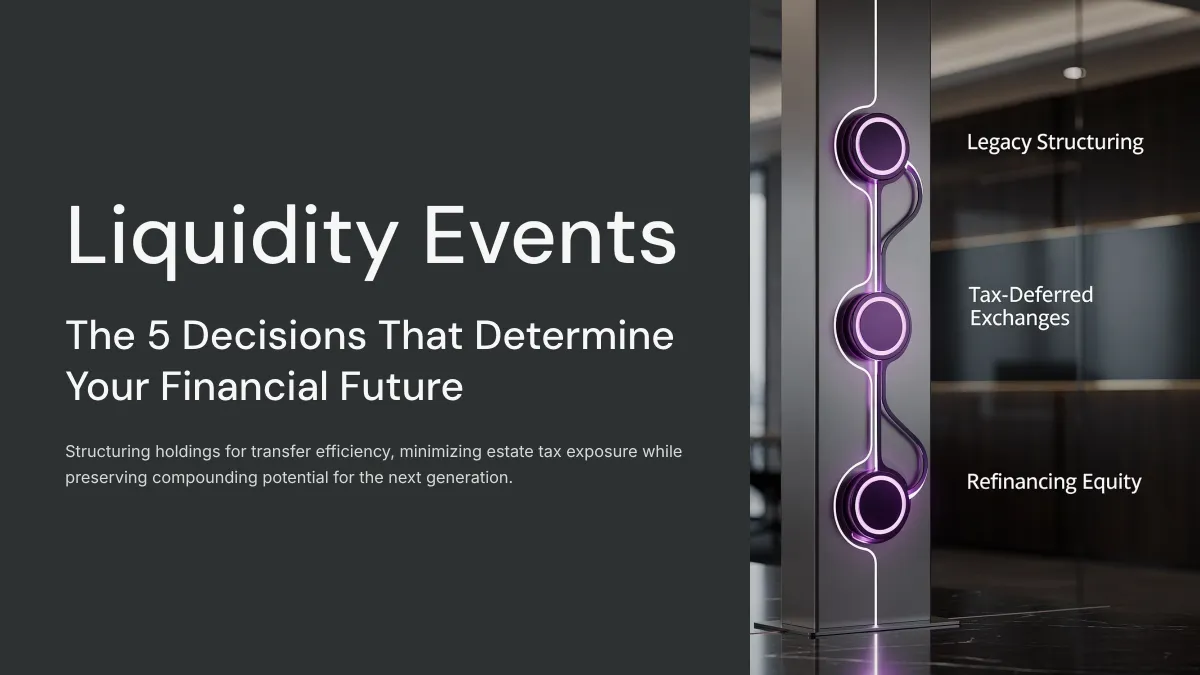
Liquidity Events: The 5 Decisions That Determine Your Financial Future
When the Money Arrives, the Clock Starts
A sale closes. A refinance funds. A business exits. The capital is real, it is liquid, and for the first time in a long time, you have choices.
Most people are not ready for that moment. Not because they have not worked for it. Because they spent years focused on producing the event and very little time planning what happens after it.
That gap is where wealth gets lost.
Four Capital Layers to Build Before the Event
The best time to prepare for a liquidity event is before it happens.
Baseline reserves. Six to nine months of living and operating expenses set aside before anything is deployed. A liquidity event is first an opportunity to breathe. Fund the baseline. Then look outward.
Opportunity reserves. Earnest money and due diligence costs arrive on a borrower’s timeline, not yours. If this layer is not in place, you cannot participate when the right deal appears.
Strike capital. Capital designated for fast execution once a deal has cleared proper underwriting. Ready to wire. Not because urgency should drive decisions, but because some opportunities require speed after the decision has already been made correctly.
Recyclers. Short-term notes at three, six, or twelve months. Capital that earns while you wait for the right long-term position.
Five Decisions That Determine What Happens Next
The refinance decision. Pulling equity through a cash-out refinance to redeploy at a higher return. The most underutilized tool in a seasoned investor’s toolkit.
The disposition decision. Selling an underperforming asset and moving capital into a higher-yield, lower-friction instrument. This requires running the return on equity calculation honestly first.
The 1031 exchange. Tax-deferred repositioning into assets with stronger cash-on-cash returns or more favorable debt structures. The timeline is strict. The discipline has to be in place before the clock starts.
The private placement. Committing capital to a structured private lending position. Passive, secured, defined-term income. This is where idle equity earns without requiring your continued involvement.
The legacy decision. Structuring holdings for transfer efficiency. Minimizing estate tax exposure while preserving compounding potential for the next generation. The earlier this conversation happens, the more options remain available.
The One Habit That Protects All of It
Run return on equity on every dollar deployed, every quarter. Track where the capital went and what it is producing.
Liquidity events have a way of becoming invisible over time. The quarterly review keeps them accountable and the decisions that followed them honest.
If a liquidity event is approaching or has recently occurred, this is the conversation to have before the capital gets deployed. A 20-minute session. No pitch. Schedule at GualterAmarelo.com.
Further Reading
Dead Equity: What Your Paid-Off Property Is Really Costing You — What idle equity inside appreciated properties is actually costing you before the liquidity event happens, and why the timing of redeployment matters as much as the event itself.
The ROE Audit: How to Know If Your Portfolio Is Quietly Underperforming — The return on equity calculation that belongs in every pre-event review, helping you identify which positions are ready to be repositioned and at what cost.
The Four Tiers of Capital: How Serious Investors Stack Their Money — The framework for assigning the capital that a liquidity event releases, so every dollar that moves has a defined job rather than a temporary home.