Stop Paying Leaders to Do Machine Work: The Power of Outsourcing with AI
There is a gap forming right now between two types of real estate investors.
On one side are the people still doing everything manually — fielding calls, entering data, chasing leases, putting out fires. On the other side are the people who have built systems, plugged in AI, and freed up their most valuable resource: their time.
That gap is growing fast. This week inside the REAP (Real Estate Acquisition Principles) community, we covered Wealth Principle 25: The Power of Outsourcing. The conversation looked very different than it did even eighteen months ago. Because outsourcing is no longer just about virtual assistants and property managers. It is about AI, automation, and building a machine that works while you focus on what actually grows your business.
Want to watch the full session first? The replay is available here: Watch the (REAP) Real Estate Acquisition Principles Call Replay →
Otherwise, let's break it all down.
Outsourcing Is Leverage, Not Delegation
Most people hear the word outsourcing and think it means handing off tasks. That is not wrong, but it misses the bigger idea.
Outsourcing done right is leverage. It means you stop trading your time for output and start building systems that create output on your behalf. In real estate, there are three areas where your time gets consumed: deals, money, and people. All three can be outsourced. And all three, to a meaningful degree, can now be handled through AI.
The goal is not to remove yourself from your business. The goal is to remove yourself from the machine work so you can focus on the growth work.
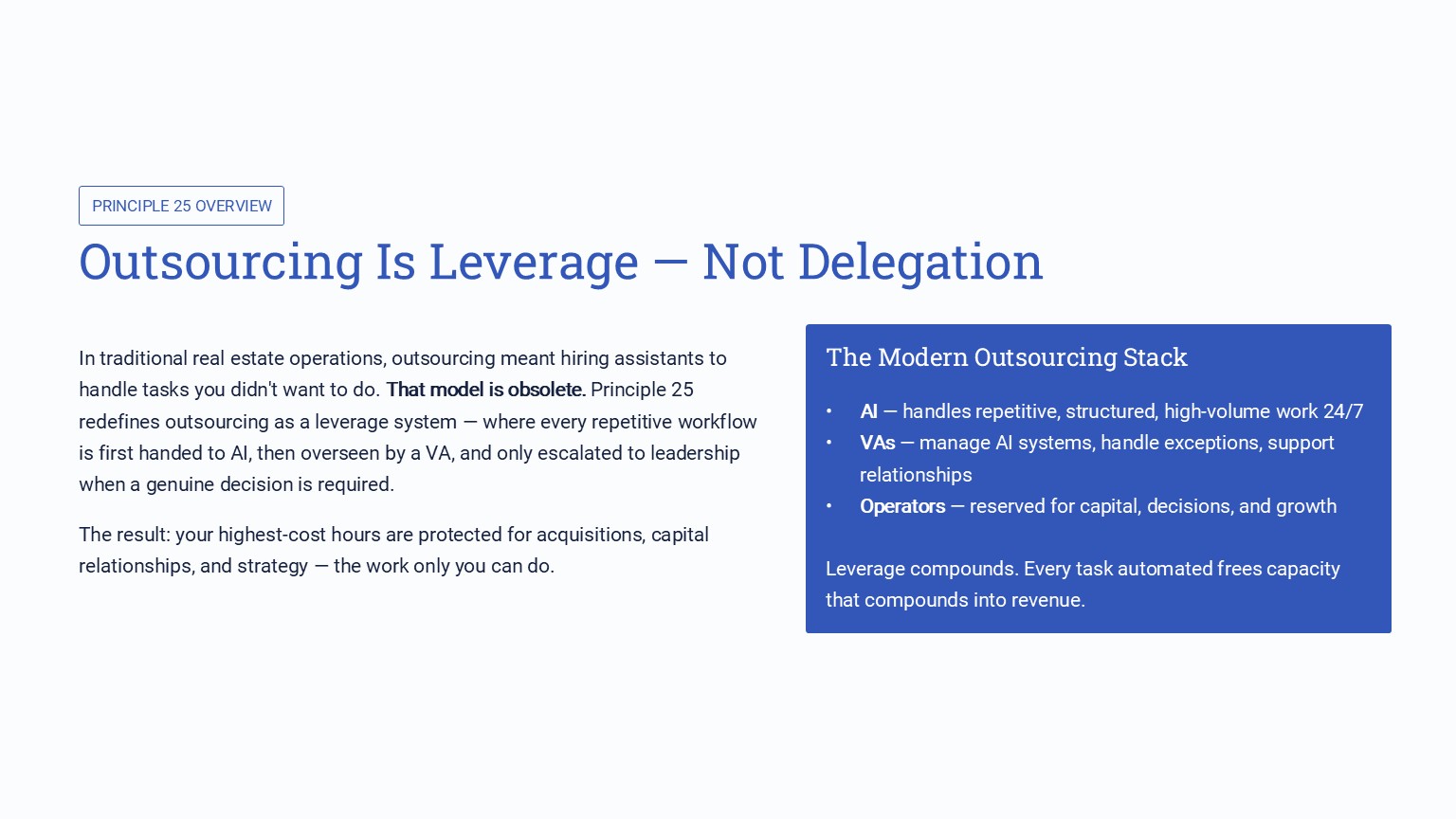
"The Modern Outsourcing Stack" showing the three-tier pyramid: AI handles repetitive work → VAs manage systems → Operators focus on capital and growth
There is one rule that makes this click: if your people are not using AI, they are not giving you their best. When I sat down with my staff and told them that not having an AI tool open on their screen all day meant they were stealing from the company, I was not trying to scare anyone. I was trying to free them. I gave them full permission to use AI, teach each other AI, and let AI teach them. The only guardrail: if money is going out, talk to me first.
That single shift changed how my entire operation runs.
The New Model: AI First, People Second
This is not a small adjustment to how you operate. It is a complete inversion of the traditional model.
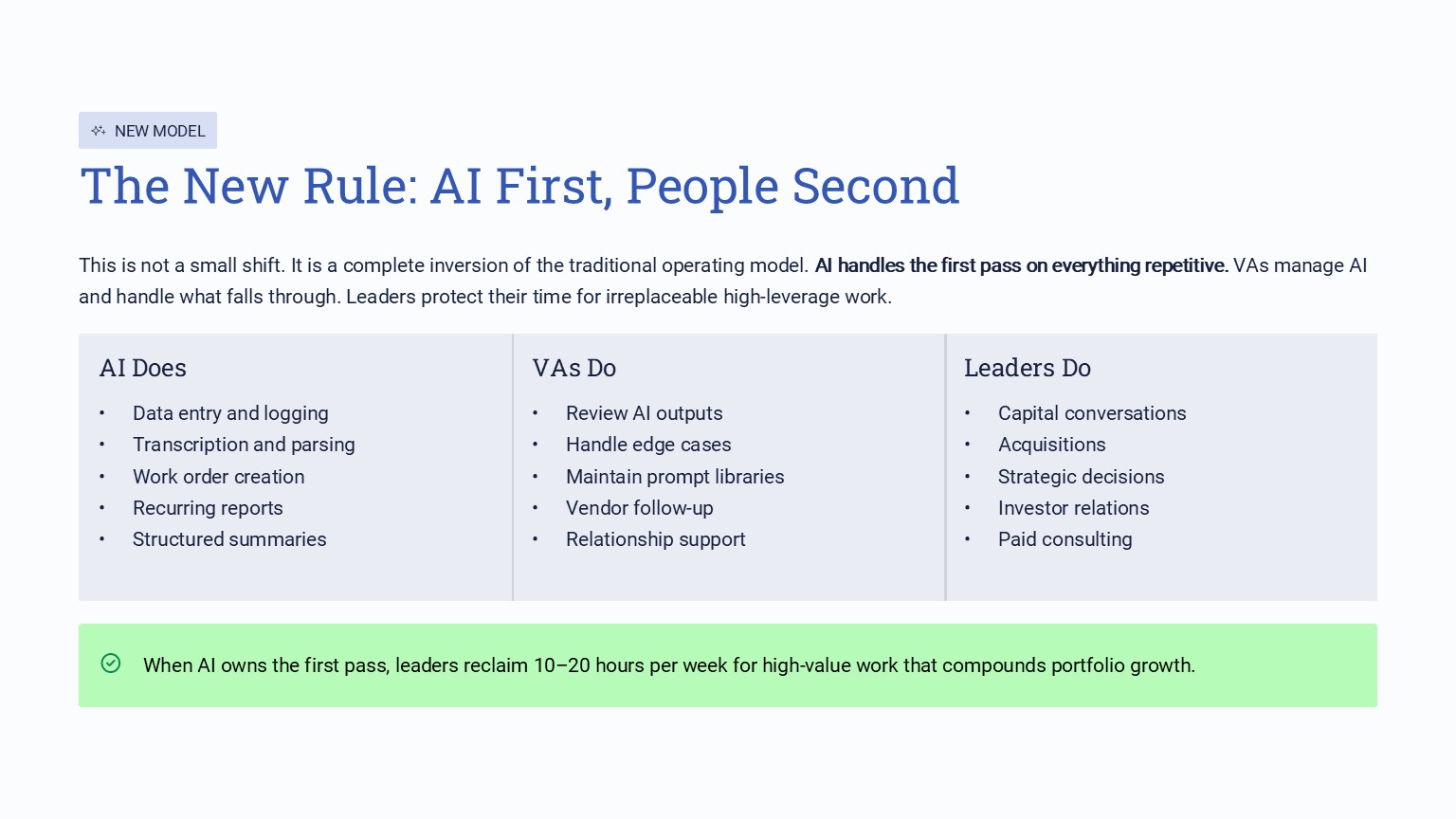
"The New Rule: AI First, People Second" with the three-column breakdown of what AI does, what VAs do, and what Leaders do
Here is how it breaks down:
AI handles the first pass on everything repetitive. Data entry and logging, transcription and parsing, work order creation, recurring reports, and structured summaries. This is machine work. Let the machine do it.
VAs manage the AI and handle what falls through. They review outputs, catch edge cases, maintain prompt libraries, follow up with vendors, and provide the human relationship layer that technology cannot replace. The ideal VA in this model is not a task-doer. They are an AI operator.
Leaders — you — protect your time for what only you can do. Capital conversations. Acquisitions. Investor relationships. Strategic decisions. That is where your hours belong.
When AI owns the first pass, operators reclaim ten to twenty hours a week for high-value work. Those hours compound directly into portfolio growth.
The Workflow: WhatsApp to Manus to AppFolio
Here is the system we use in our own property management operation, and the one I recommend you build toward.
Field updates come into WhatsApp. From there, Manus picks up the message, transcribes it if it is audio or video, confirms the summary, and logs it directly into AppFolio. What used to require a VA manually entering data into a spreadsheet now happens automatically. The VA's job shifts to reviewing what the AI produced and training the bot when something goes wrong.
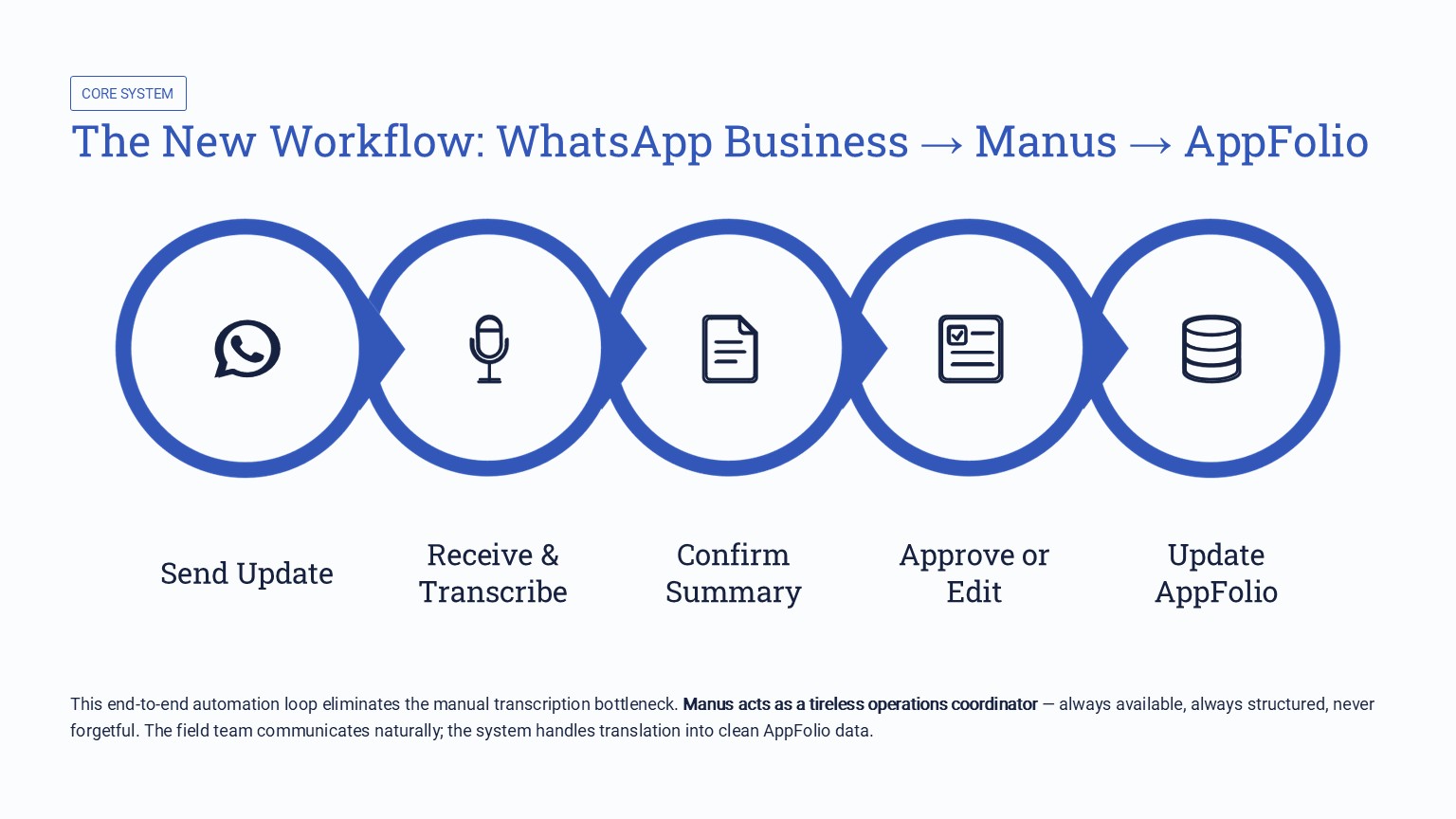
"The New Workflow: WhatsApp Business → Manus → AppFolio" showing the five-step automation loop
That last part matters. When the AI creates a work order incorrectly, the VA does not just fix it. They figure out why the prompt failed and improve it. The system gets smarter over time, and your people develop real skills as AI operators rather than data entry clerks.
This took time to set up. But once it is built, you do not have to build it again. And the failure rate of a human doing the same task manually every day is taken out of the equation entirely.
The Difference Between a Good Update and a Useless One
This is one of the places the system breaks down, and it is worth being direct about it.
When your field team sends a message that just says "Done" or "Fixed the thing," the AI cannot work with it. It flags the update as incomplete and sends a question back. That back-and-forth adds friction — the opposite of what you are building for.
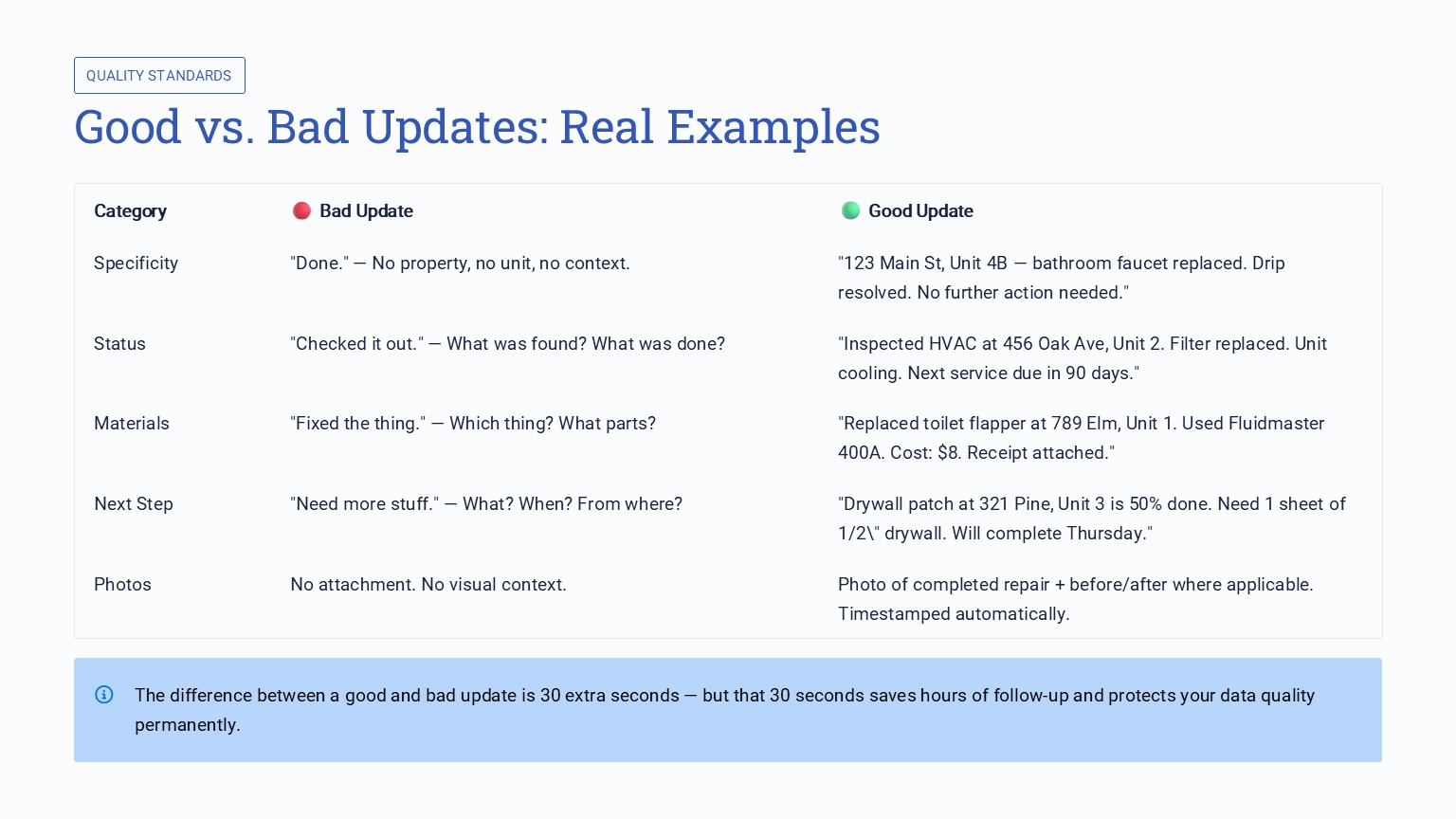
"Good vs. Bad Updates: Real Examples" comparison table
The standard we enforce is simple: every field update starts with Property + Unit + Issue.
A bad update: "Fixed the sink." A good update: "456 Oak Ave — Unit 2A — kitchen sink clog cleared. Drain flowing freely. No parts needed. Job complete."
The difference is about thirty extra seconds from your field team. What that thirty seconds buys is hours of saved follow-up, a clean paper trail, and an AppFolio record that actually reflects what happened. Train your team on the format once. After that, the system enforces it by flagging incomplete submissions automatically.
Matching the Right AI to the Right Job
Not all AI tools are built for the same purpose. Using the wrong one is like bringing a hammer to a surgery. Here is how I think about the stack.
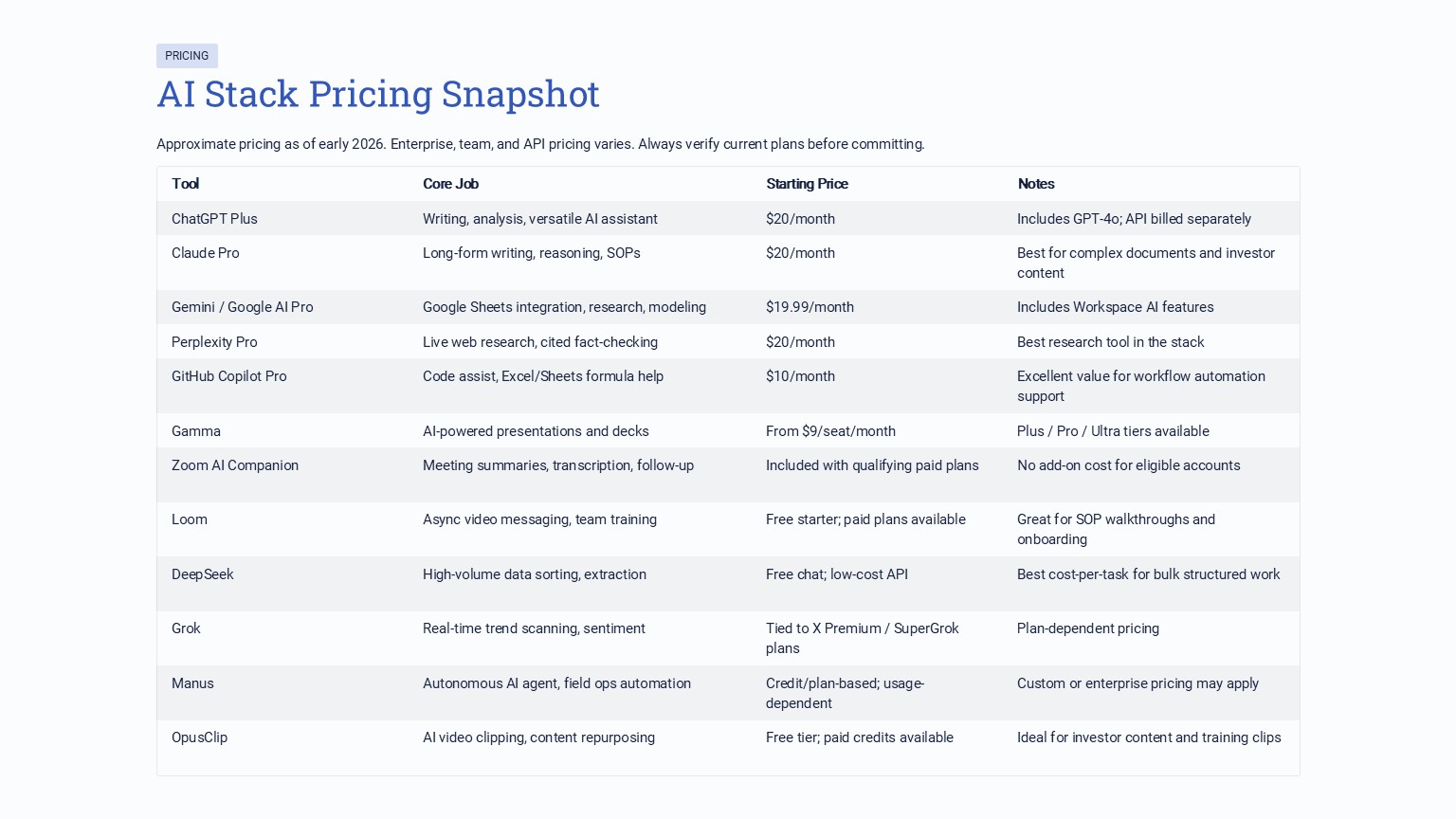
"AI Stack Pricing Snapshot" table showing all tools, their core jobs, and monthly costs
Heavy data sorting and financial analysis — DeepSeek. It outperforms ChatGPT significantly when it comes to numbers, spreadsheets, rent rolls, and T12 analysis. ChatGPT will hallucinate on numbers. DeepSeek is sharper, faster, and free.
Excel and financial modeling — Gemini or Copilot. Gemini inside Google Sheets is powerful for collaborative work and will make changes to your cells, not just tell you what to do. For building multiple dashboards or complex acquisition models, Shortcut or Copilot embedded in Excel is the stronger call.
Long-form writing, emails, scripts, SOPs, and investor content — Claude. Hands down. It is more data-accurate, less biased, and produces better output for anything requiring real reasoning and voice. I put Claude over ChatGPT all day for copywriting, website development, and staff training scripts.
Brainstorming and personal memory — ChatGPT. It still has a role. I use it to store conversations and brain dumps so I can return later and ask what stories or concepts I have built up around a topic. It knows you well. Just do not trust it for hard research or numbers.
Research and fact-checking — Perplexity. When I need to verify where information came from — especially for legal questions or market selection — Perplexity is my first stop. Its citation quality is exceptional. Grok is faster but less rigorous on sourcing. I often run both as a two-step verification process.
Execution — Manus. This is the one that changes everything.
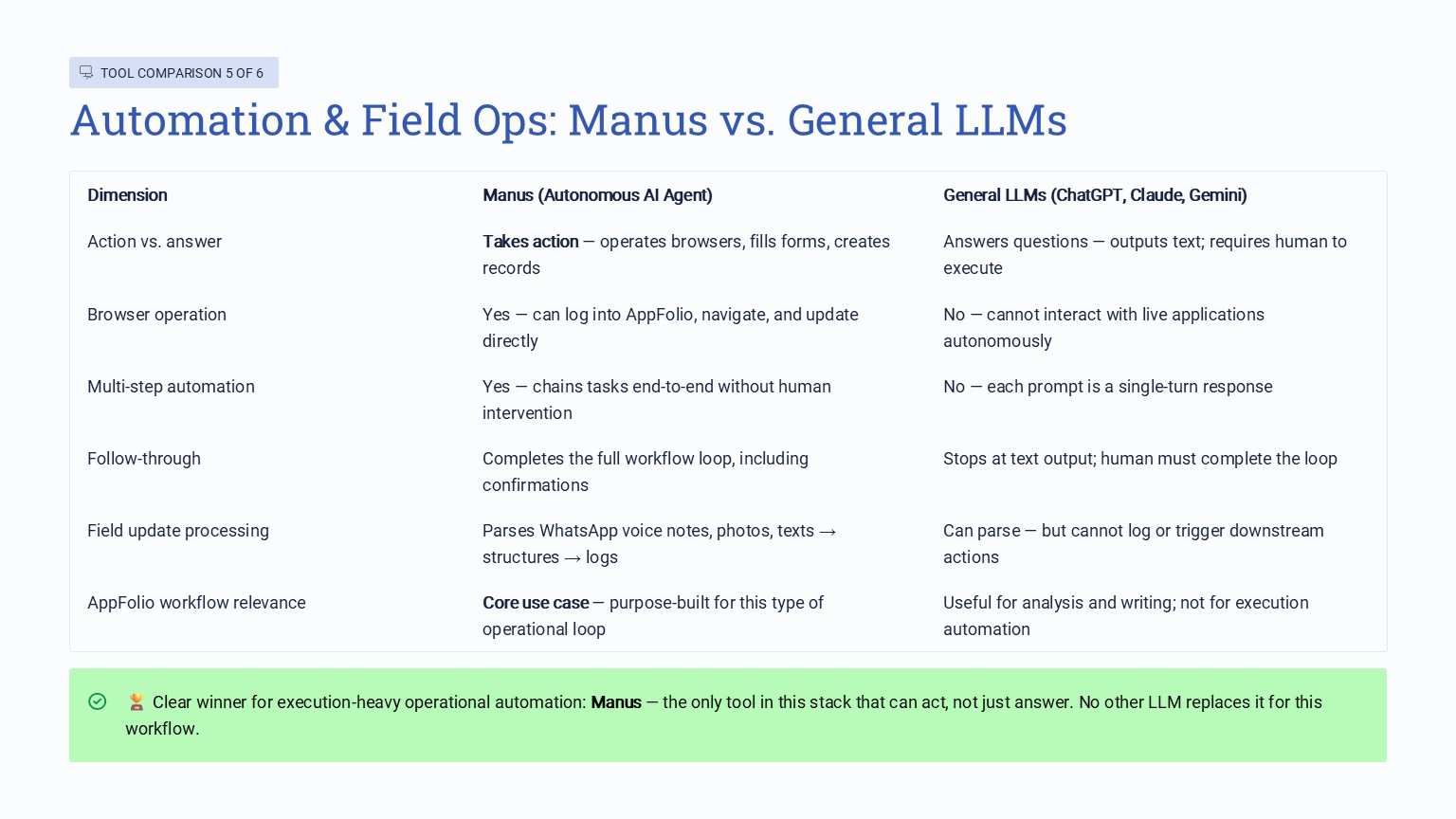
"Automation & Field Ops: Manus vs. General LLMs" comparison table
General AI tools answer questions. Manus does things. It connects to your software, executes workflows, writes code, builds websites, and takes action on your behalf. The AlchemistNation.com site you are seeing update right now? Built in Manus. Our 200-page company SOP? Built using Manus alongside Claude and Grok, then deployed so Manus now knows exactly how I want my company to run.
The workflow I used to build this week's training presentation: Grok for research, ChatGPT to apply my voice and filter, Gamma to produce the final slides. Three tools. One seamless output. Built in about ten minutes before the call started.
What Does This Actually Cost?
Here is the honest answer. You can build a fully functional AI stack for your real estate business for around $600 a month — and that budget will protect and generate multiples of itself in owner time, better decisions, and operational accuracy.
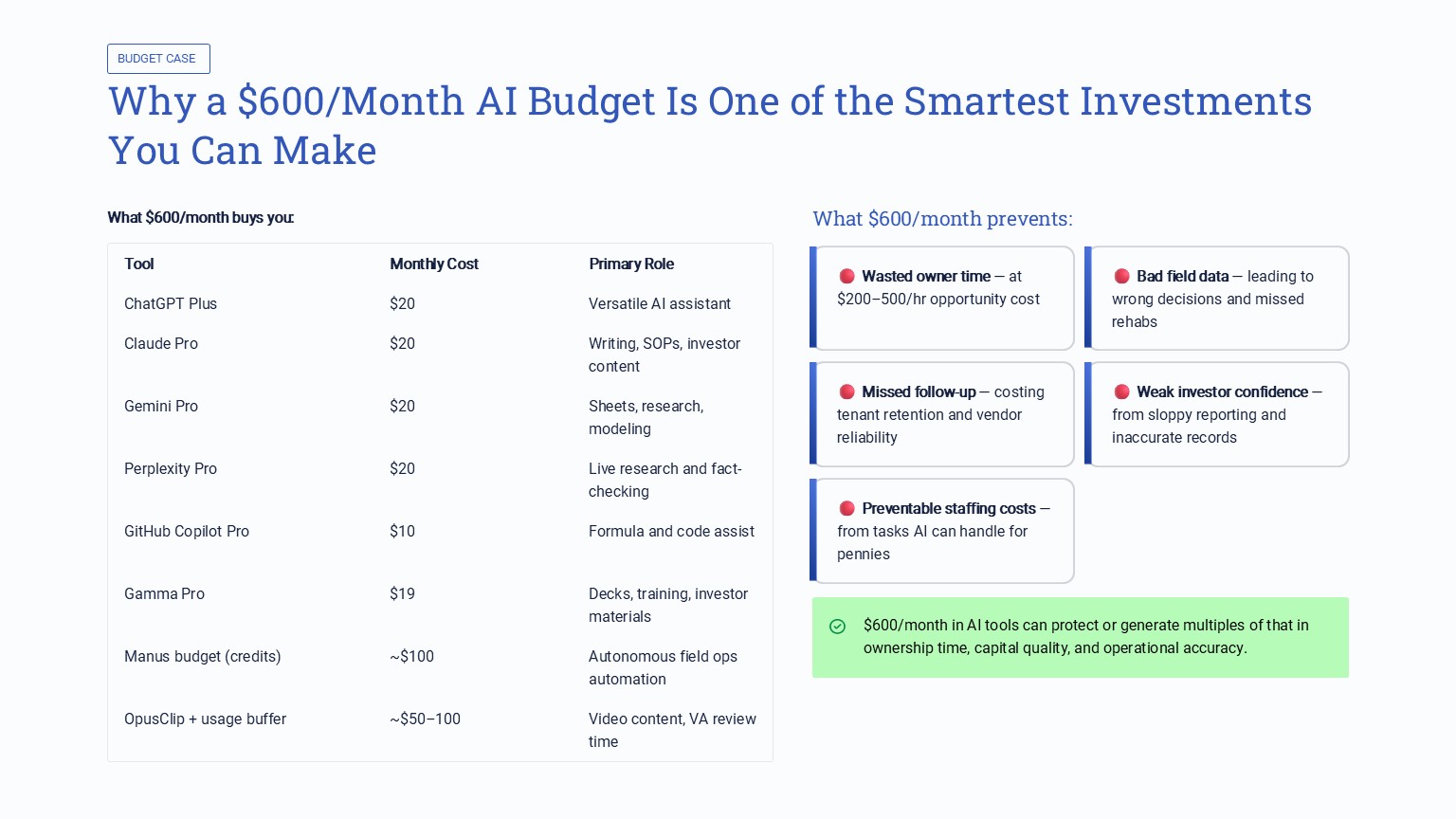
"Why a $600/Month AI Budget Is One of the Smartest Investments You Can Make" showing the full stack breakdown and what the budget prevents
The core stack — ChatGPT Plus, Claude Pro, Gemini Pro, Perplexity Pro, Copilot, and Gamma — runs about $110 a month. Add Manus credits and an operational usage buffer and you are in the $600 range fully loaded. What does that $600 a month prevent? Bad field data leading to wrong decisions. Missed follow-up costing tenant retention. Weak investor confidence from sloppy reporting. Owner time billed at $200 to $500 an hour being spent on work a bot could do for pennies.
This is not an expense. It is a leverage investment.
Where Virtual Assistants Still Win
AI does not replace your VAs. Let me be direct about that.
What it does is elevate them. We currently run eighteen VAs, and their role has shifted significantly. They are no longer spending most of their time on data entry. They are spending it on leasing communication, collections relationship management, reviewing AI outputs, and making sure residents feel seen and heard.
That last one matters more than people realize. We spend close to $5,000 a month on VAs whose primary job is to touch the customer — to check in, to inform, to make them feel like someone cares. We can afford to invest in that relationship layer because the technology is handling everything else.
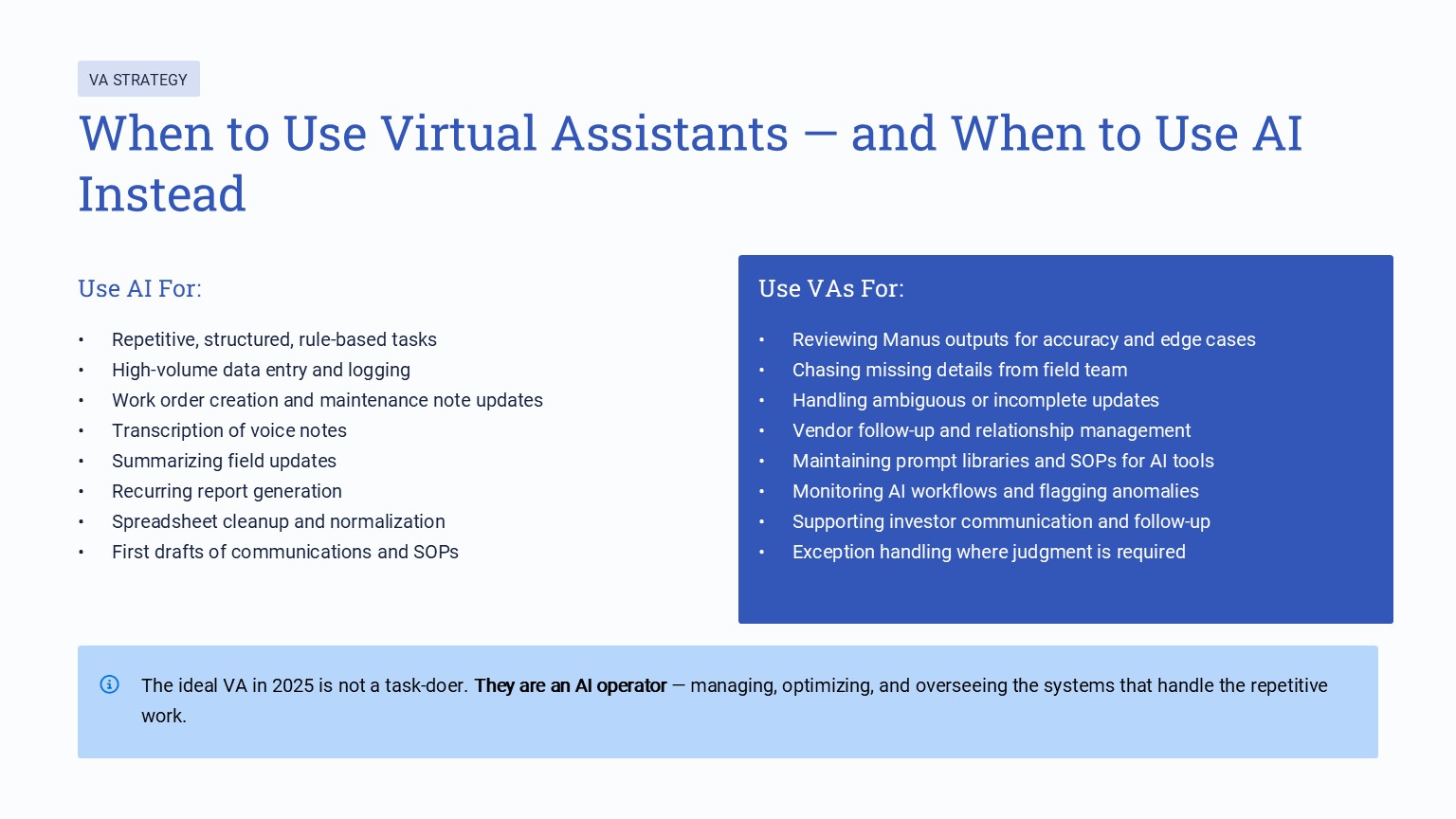
"When to Use Virtual Assistants — and When to Use AI Instead" with the two-column breakdown
If a phone number is not going through, a VA catches it. If a vendor is ghosting, a VA follows up. The soft touch, the human judgment call, the edge case that no prompt library has accounted for — that is where your people live and where they add irreplaceable value.
Full Isn't Stable — A Real-World Example
I will give you something concrete. We own a 34-unit building I call Super Luxor. Split utilities, individual HVAC, off-street parking, four towers on one site, all brick. Thirteen months in, it hit 100% occupancy.
And I immediately looked at my collections report and found eighteen people behind on rent.
Full is not stable. 100% occupancy and 100% collections are two very different things. When everyone is in and everyone is paying, that is when you are running a real business. Until then, you are managing a situation.
We dug in. Six of those eighteen were government aid tenants whose payments had been held up because an inspector failed their units — over a neighbor's blown-down fence. Not our fence. Ours was fine. But that is the kind of thing you find when you look closely and your data is clean enough to look at.
The good news is that once an eviction process starts in our system, everything is automated. The workflow team gets a budget flagged for unit turnover. Marketing starts pre-leasing two weeks out. We are planning for it before it happens. That is what systems built on AI and clear processes can do — they turn reactive chaos into a proactive, predictable operation.
Your Action Steps This Week
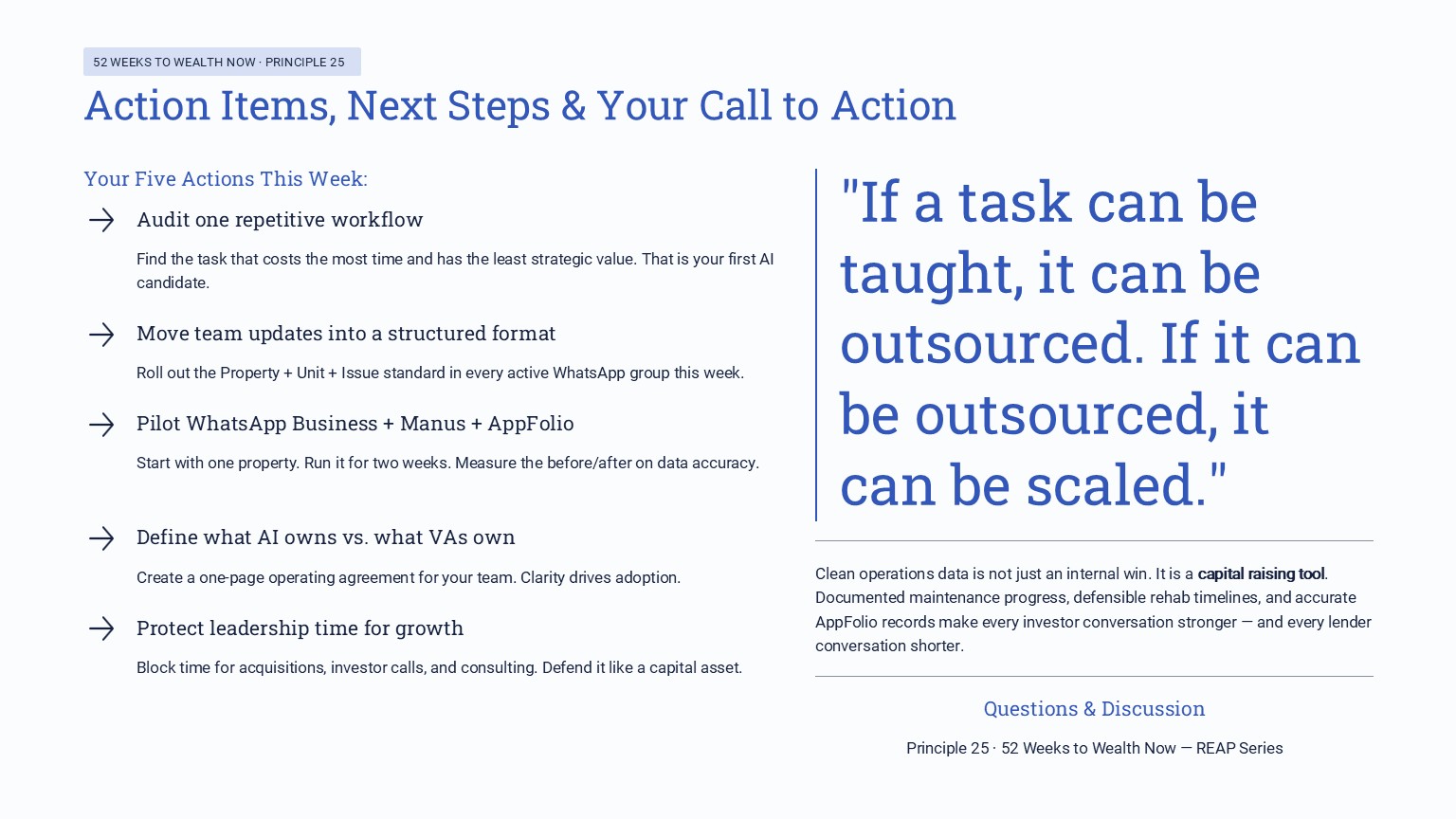
"Action Items, Next Steps & Your Call to Action" with the five-step list
Audit one repetitive workflow. Find the task that costs the most time and has the least strategic value. That is your first AI candidate.
Move team updates into a structured format. Roll out the Property + Unit + Issue standard in every active WhatsApp or Slack group this week.
Pilot the WhatsApp to Manus to AppFolio workflow. Start with one property. Run it for two weeks. Measure the before and after on data accuracy and time spent.
Define what AI owns versus what your VAs own. Write it down. One page. Clarity drives adoption.
Protect your leadership time like a capital asset. Block time for acquisitions, investor calls, and strategy. Defend it. Everything else is building the machine to support it.
And one final piece of advice that came straight from the community during this call: before you pick your AI tools, pick the result you are looking for. Start with the outcome. Then find the one tool that helps you get there. Go deep in one lane before expanding. Do not get out of it until you have made it work completely.
The Bottom Line
Sixteen years ago, I saw a gap forming in wealth. I crossed over and threw the rope back. Not everyone took it.
I see the same gap forming right now with AI. The investors who are building these systems, learning how they work, and plugging them into their businesses are going to look very different from everyone else in the next two to three years. Not because they are smarter. Because they built the machine while everyone else was still doing the machine's work themselves.
You do not have to become a developer. You do not have to understand every tool. But you do have to start.
Make more money. Do less machine work. Let the system deliver the output. That is the game we are playing inside Alchemist Nation — and you are already in the right room.
Watch the Full Replay
The live session went deeper on every tool comparison, walked through the real Manus workflow build, and included a live look at how this week's presentation was created in real time using Grok, ChatGPT, and Gamma.
Watch the (REAP) Real Estate Acquisition Principles Call Replay →
Call To Action
Join us live every Saturday at 10:00 AM ET inside the Alchemist Nation Community at AlchemistNation.com. We cover real deals, real tools, and real strategy — and we do the work alongside you. If you are ready to stop working in the machine and start building one that works for you, this is the community that will get you there.
Further Reading
From Active to Passive: The Identity Shift That Changes Everything — What to do with the hours and mental bandwidth this AI system frees up: the transition from operating your portfolio to letting the structure run it.
The Banker Mindset: Why the Safest Investors Stop Thinking Like Operators — Why the capital conversations, acquisition decisions, and investor relationships this system frees you up for require a different identity than the one that built the portfolio.
The Four Tiers of Capital: How Serious Investors Stack Their Money — How to assign the capital your AI-optimized operation is protecting and growing, so every dollar has a defined job at every stage of the portfolio.