REAP Principle 27: Create a Steadfastness of Your Faith
Over the years, I've interviewed thousands of people, including more than 500 millionaires and over five billionaires. I wasn't trying to find their secret investment strategy. I was looking for something deeper. And what I found was almost shocking in how simple it was.
Every single highly successful person I interviewed carried, from a very young age, an unshakeable belief that they were going to be successful. It wasn't arrogance. It was certainty. They just knew.
And the people who weren't successful? They also had a belief from a young age, just in the opposite direction. I've had conversations with residents in my own buildings who told me flat out: I don't want the responsibility. I don't want the risk. I just want to be comfortable.
Think about that for a second.
Both groups were right, not because the universe plays favorites, but because belief shapes decision-making, and decision-making shapes results. REAP Principle 27 is built on that reality.
Wealth Principle 27: Create a Steadfastness of Your Faith.
What Faith Has to Do With Your Portfolio
When we say faith in this context, we're not talking about religion, though faith in that sense matters too. We're talking about your operative belief system around money, assets, time, and possibility.
Here's a useful frame: faith in solutions versus faith in problems.
Every investor I've met who's stuck is stuck because they're focused on what's wrong, the market, the rates, the timing, the uncertainty. Every investor I've met who's moving is focused on what's possible. Same market. Same rate environment. Completely different internal reality.
The world you focus on is the world you build toward. That's not motivational language — it's the operating principle behind every decision you'll ever make.
Why Intelligence Alone Won't Get You There
Think about AI. These tools are extraordinarily capable. They have access to enormous amounts of information and can produce sophisticated output. But here's the thing: until you show up with a prompt, nothing happens. The screen just sits there.
That's what intelligence looks like without belief.
You can have a PhD, attend every real estate conference, read every book, and still not do a single deal, because doing a deal requires a decision, and decisions are not made without belief that a result is possible. Belief isn't the nice-to-have part of wealth building. It's the ignition switch.
I've been in rooms with people learning the same exact material as my community. Same content. Same teachers. Some people walk out and implement. Some people walk out and say, yeah, that would never work for me. The only meaningful difference? What they believe.
The Scale of the Opportunity (And Why You Should Believe)
Here's something worth knowing when you're deciding whether to anchor your faith in real estate and passive income.
Total global wealth is estimated at around $1,000 trillion. Of that, roughly $33 trillion is in gold, $89 trillion is in the stock market — and $680 trillion is in real estate. That's not a typo. Real estate represents the single largest store of wealth on the planet, and it is open to any human being who chooses to participate in it.
There's no draft. There's no draft lottery like the NFL where only one quarterback gets the job. The asset class is massive, and your belief about whether you belong in it is the main barrier between you and it.
The 8-Step Path From Active Income to Passive Wealth
This is where the belief gets practical. Here are the eight stages of building a real portfolio:
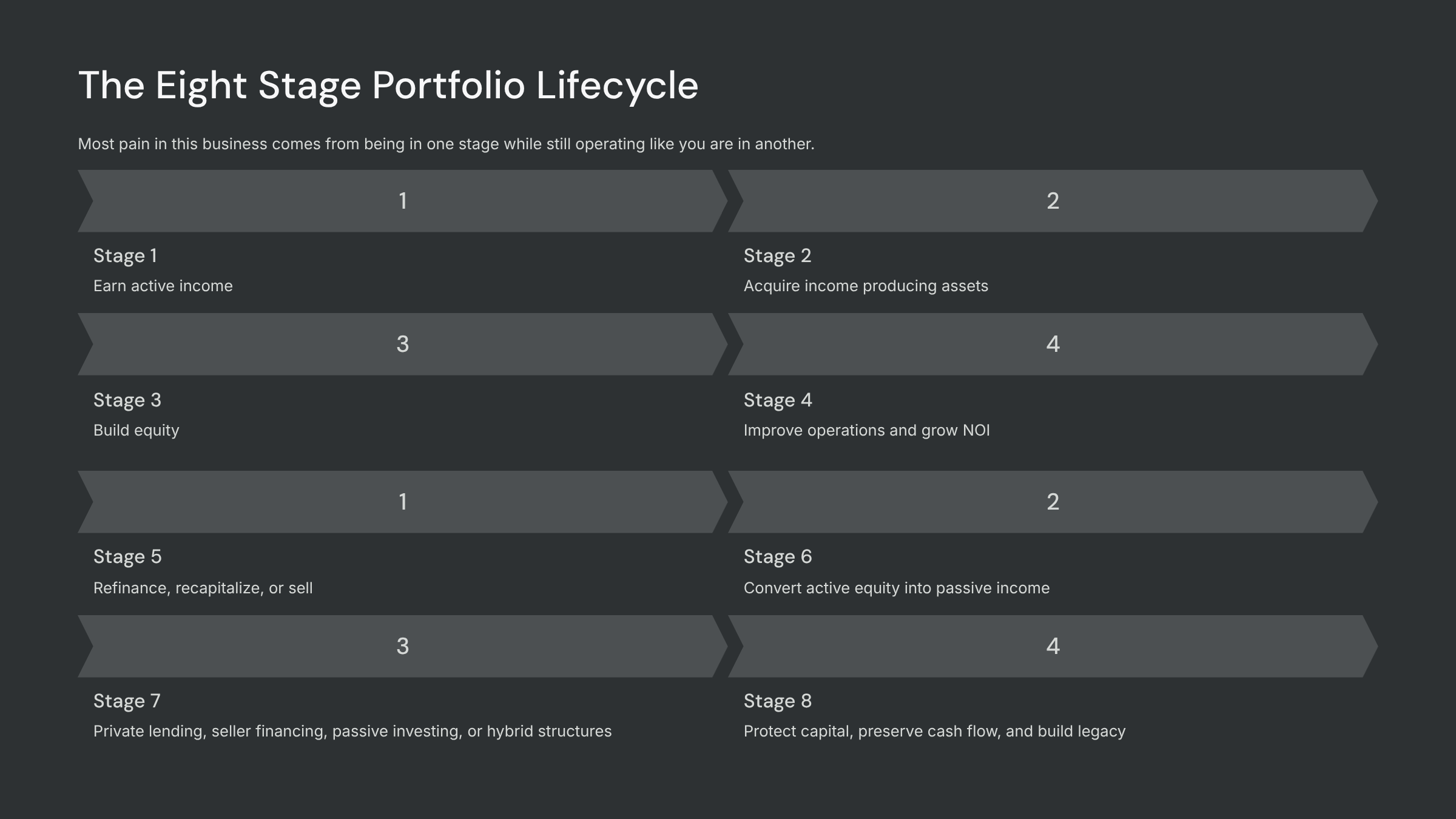
Step 1 — Earn active income. Everyone does this. It's the starting point.
Step 2 — Acquire income-producing assets. Most people never get here. This is where the real shift begins.
Step 3 — Build equity. Hold assets long enough, or force appreciation through value-add work. You don't have to wait decades, smart operators create appreciation in a year or two.
Step 4 — Improve operations and grow NOI. This is how you squeeze extra equity out of what you already own.
Step 5 — Refinance, recapitalize, or sell. This is where most people freeze. It's emotional. It requires decisions beyond the original purchase. Many people stay in Stage 3 indefinitely because Stage 5 feels scary.
Step 6 — Convert active equity into passive income. Very few investors reach this stage. But it's where the real freedom begins.
Step 7 — Private lending, seller financing, passive investing, or hybrid structures. Your capital starts doing the work.
Step 8 — Protect capital, preserve cash flow, and build legacy wealth. This is what every financial planner talks about, but if you don't have assets yet, there's nothing to protect. Do the growth work first.
The "messy middle" is Steps 3 through 6. It's where most people stop — not because they lack intelligence, not because the market won't cooperate, but because they don't believe they're the person who crosses to the other side.
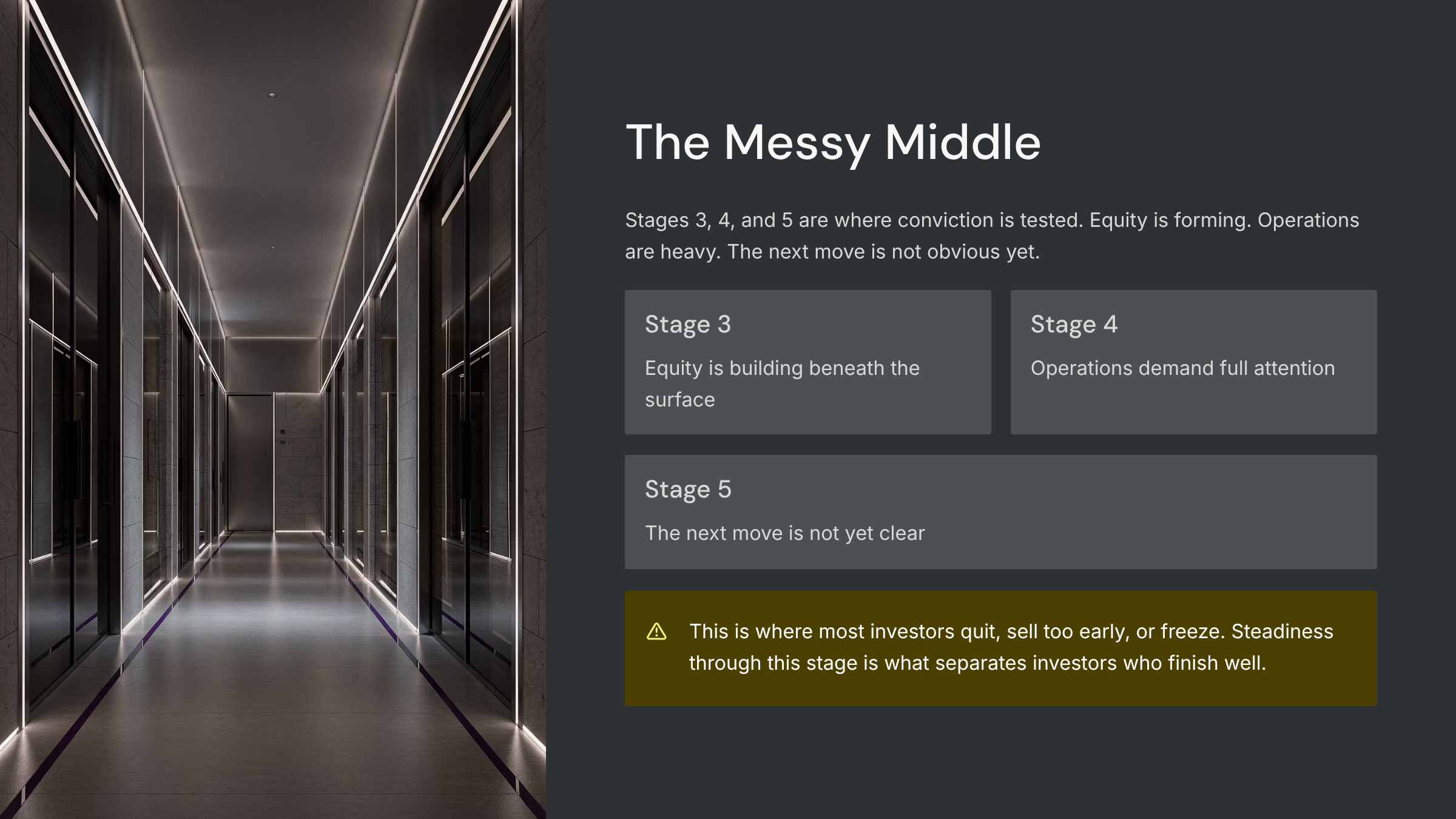
This is also where dead equity quietly accumulates, equity that exists but isn't working, sitting in assets that have never been asked to do more.
The Quiet Shift That Nobody Talks About
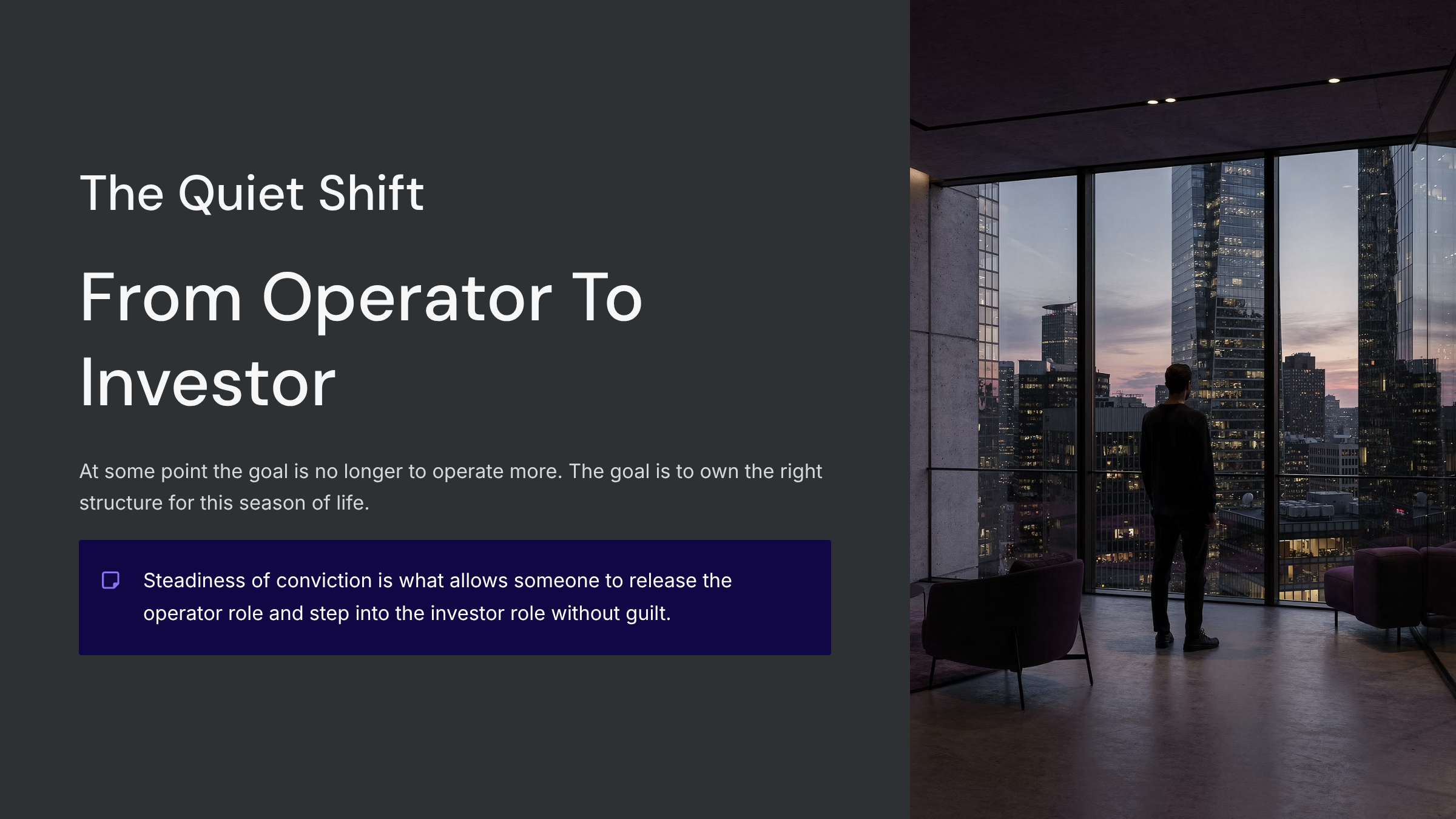
Here's something the world doesn't give you credit for: making the move from operator to investor.
The world gives you dopamine for being the guy with the projects, the flips, the buildings under construction. There's a social status to being active in that way. But the person who's quietly lending, earning passive income, managing a clean portfolio? There's no applause for that. No Instagram moment. Just compound growth and freedom.
That shift, from operator to investor, is the real prize. And most people don't make it because they haven't given themselves permission to step back. They keep operating because the asset seems to need them, or because their identity is still tied up in the hustle rather than the outcome. I wrote about this transition in depth in From Active to Passive: What the Transition Actually Looks Like and the psychology behind it is more of the barrier than the strategy.
I know people who have flipped 350 homes and still aren't financially free. I know landlords with dozens of units who are house-rich and cash-poor. Being busy is not the same as being wealthy. The goal is to build something that produces income whether or not you're in the room.
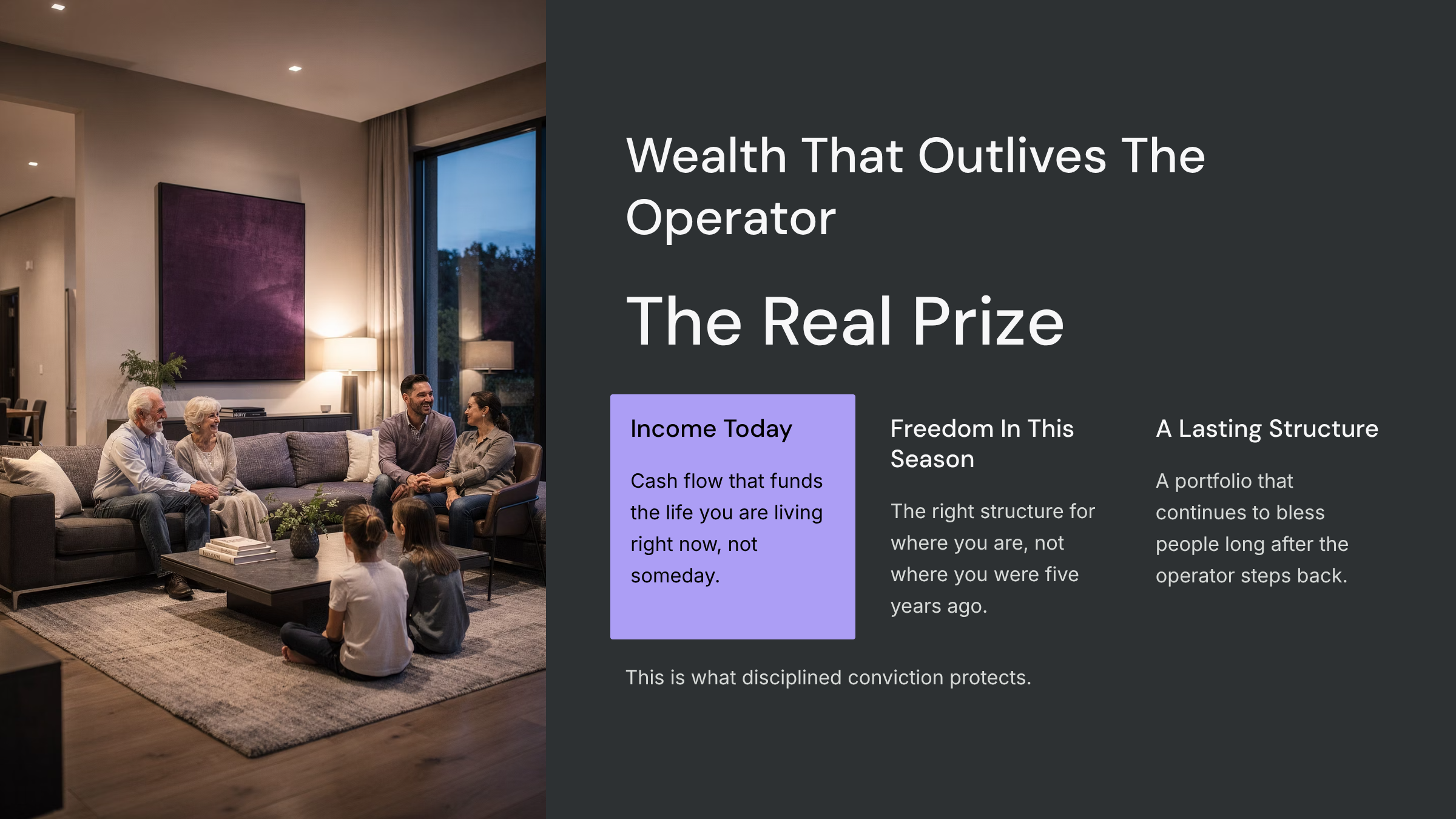
A wealth structure that outlives the operator is the real prize. And here's what's wild about that: if it can work without you when you're gone, it can work without you right now, which means you can live in it today.
Five Questions to Ask About Your Equity Right Now
Your equity has a job. If it's not working, that's a problem. Before you can answer these questions with any clarity, you need to know what your equity is actually earning. That starts with running a full return on equity audit on everything you hold. Once you have those numbers in front of you, ask:
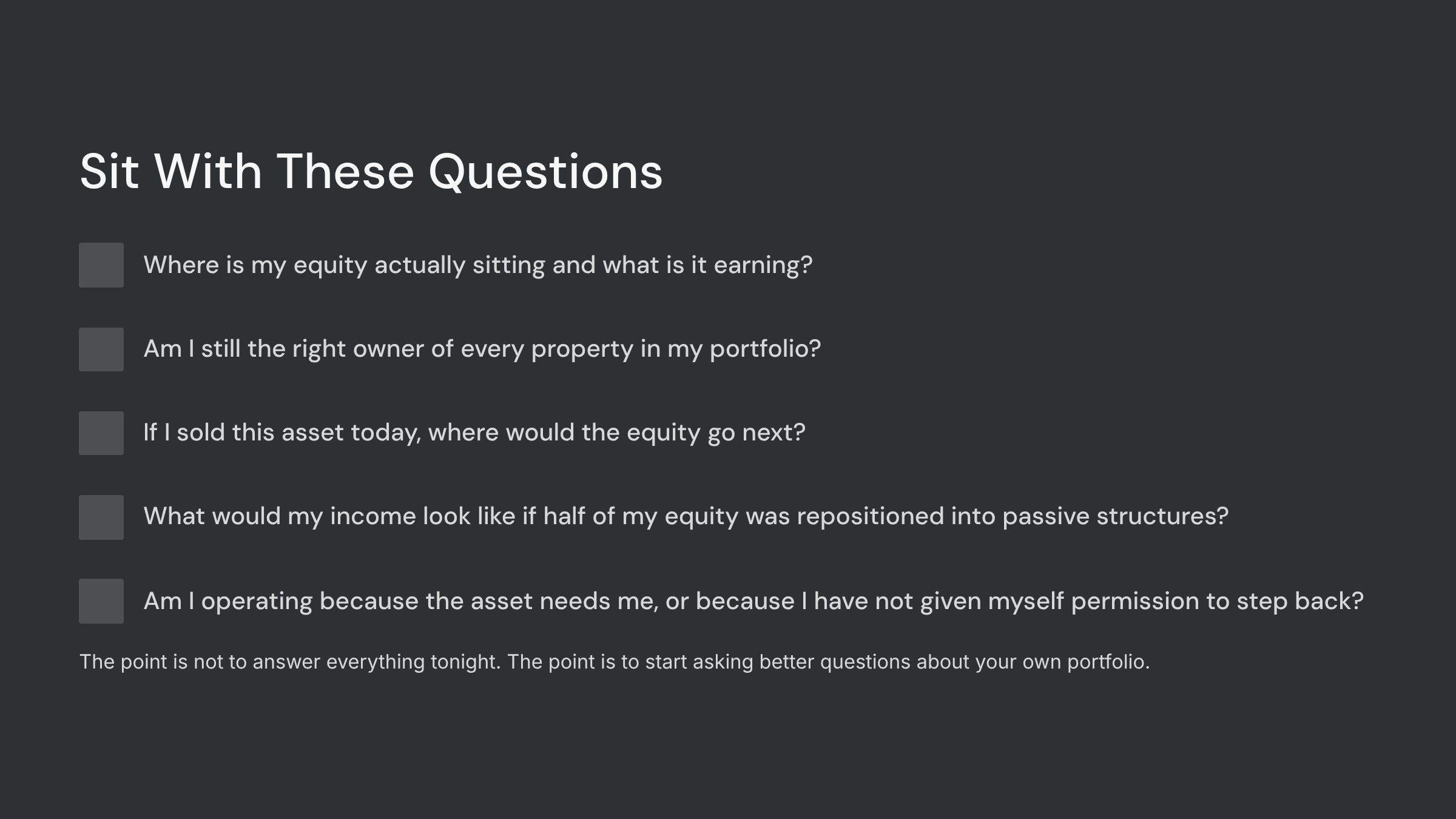
Where is my equity actually sitting, and what is it earning?
Am I still the right owner of every asset in my portfolio? There's a season for every investment. Not every asset deserves to stay with you forever.
If I sold today, where would the equity go next? Cash is a valid answer. Liquidity has strategic value.
What would my income look like if half my equity was repositioned into passive structures? Most investors haven't run this number.
Am I operating this asset because it needs me — or because I haven't given myself permission to step back?
You don't have to answer all of these perfectly. The point is to start asking better questions about your own portfolio and your own life.
Common Mistakes With Mature Equity
Even experienced investors fall into these traps:
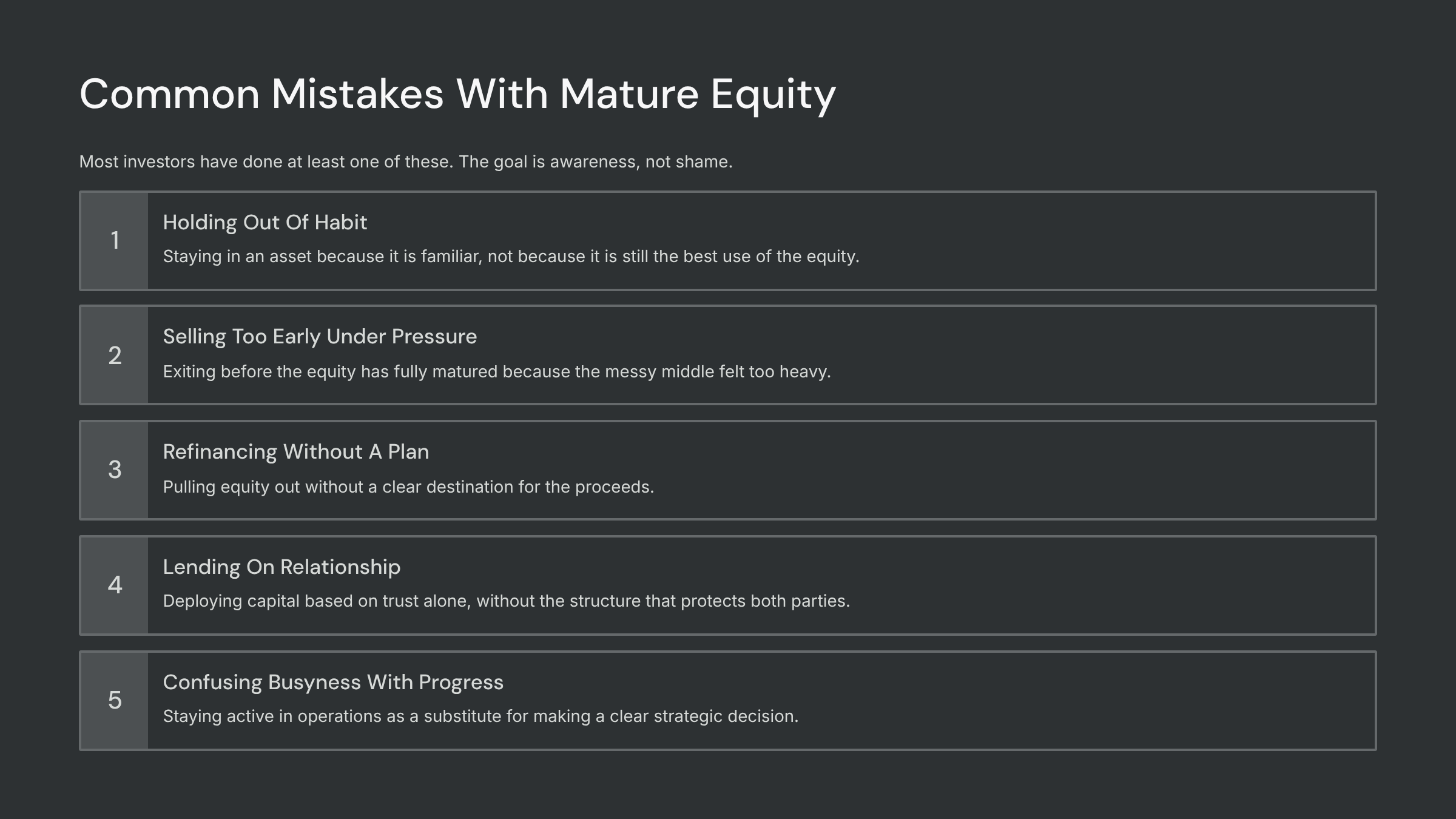
Holding out of habit. You hold because you've always held. But holding without intention isn't a strategy, it's inertia.
Selling too early under pressure. If you haven't done your value-add work, if the timing isn't right, selling before the play matures can cost you significantly.
Refinancing without a plan. Pulling equity out is only smart if the new deployment earns more than the cost of the capital. Know where the money is going before you pull it.
Lending on relationships alone. Trust matters, but structure protects both parties. Deploying capital without proper collateral and legal framework is not a lending decision, it's a gamble. The five-step underwriting framework exists for exactly this reason.
Confusing busyness with progress. Exhaustion is not evidence of productivity. Hard work that doesn't produce results is just hard work. Always ask: what is this activity actually producing?
How to Rewire Your Belief System Starting Today
You may not have been given the right environment to believe what you need to believe in order to get where you want to go. That's not a life sentence. Belief can be recoded.
Here's the practical approach:
Write down the belief you want to have. Not how you feel today, how you want to feel. Not where you are — where you want to be. Then ask yourself: What would a person who believes this about their future do today?
If you believe you're an investor who earns passive income, you underwrite deals. You document everything. You communicate clearly. You track results. You plan your exits in advance. You start thinking like a capital allocator, not an operator. You don't wait for the perfect feeling — you move with the conviction that this is who you are.
Recoding can happen fast. Thoughts fire instantaneously. The work is in reinforcing the right thoughts until they become the default.
The book The Wealthy Gardener by John Soforic does a masterful job of illustrating this. It's the story of a chiropractor who moved to a town of 17,000 people, went to his quiet place, and simply decided the phone was going to ring. Without advertising. Without a big launch. He just held that belief — and the phone started ringing. It's a book worth reading more than once.
Actionable Takeaways
Identify one belief you currently hold about money, assets, or your own capabilities that is limiting your decisions. Write it down.
Write down the belief you want to replace it with and document it somewhere visible.
Run your equity through the five questions above. Know where your capital is and what it's earning.
Ask yourself honestly: am I in the messy middle because the situation is hard, or because I haven't made the decision to move through it?
Read The Wealthy Gardener by John Soforic. Seriously.
Further Reading
Dead Equity: What Your Paid-Off Property Is Really Costing You — If your belief is shifting toward putting capital to work, this is the first number you need to confront.
The ROE Audit: How to Calculate What Your Equity Is Actually Earning — The practical tool to back up everything this principle teaches about knowing where your equity stands.
The Banker Mindset: Why the Safest Investors Stop Thinking Like Operators — The identity shift that makes the belief change structural, not just motivational.
Further Reading
The Four Tiers of Capital: How Serious Investors Stack Their Money — The structural framework for organizing portfolio capital so that each of the eight stages in the lifecycle has a defined purpose and the portfolio can function without your daily presence.
The Banker Mindset: Why the Safest Investors Stop Thinking Like Operators — Why the transition from operator to investor described in this post is ultimately an identity shift, and what it looks like when capital starts doing the work.
How to Evaluate a Private Lending Deal — Once your capital is ready to move into Step 7, this is the five-step underwriting framework that protects it when it does.
Ready to Go Deeper?
Want to go deeper on building the mindset and strategy to create passive, lasting wealth? Join us every Saturday at 10:00 AM ET for REAP — Real Estate Acquisition Principles where we cover one wealth principle per week inside the Alchemist Nation community. Next week we're diving into Principle 28: learning to love dealing with large amounts of money and the people who have it. You don't want to miss it. Visit AlchemistNation.com to learn more and get connected.