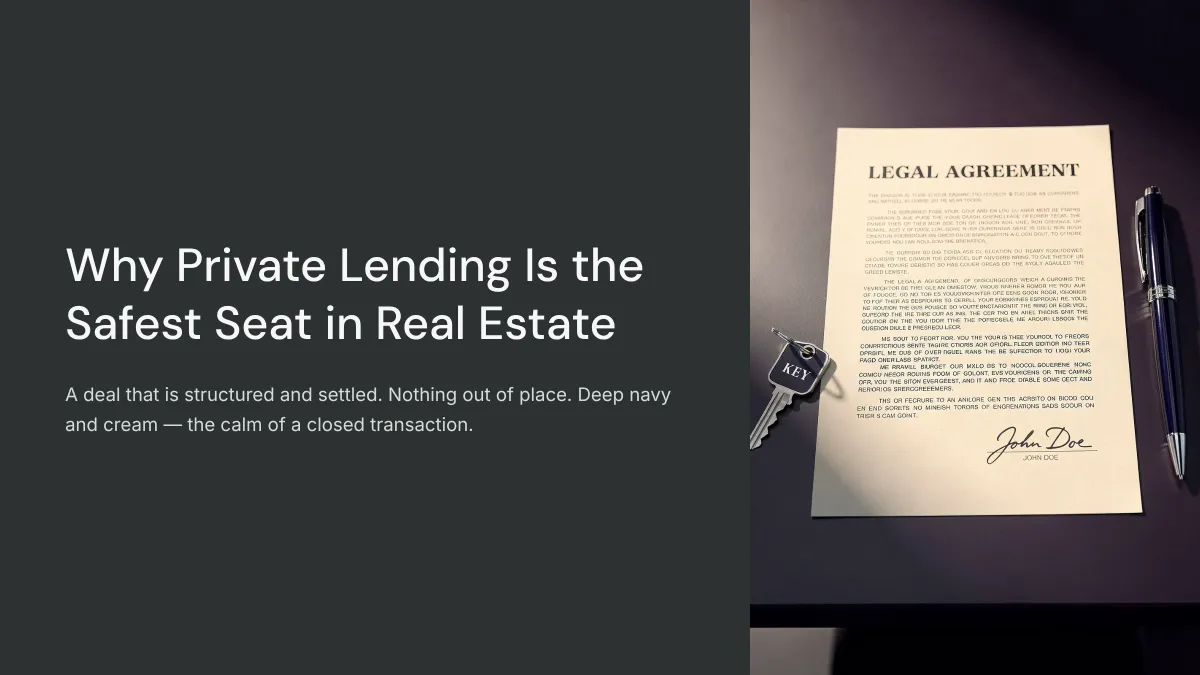
Why Private Lending Is the Safest Seat in Real Estate
The Operator Carries Everything. The Lender Carries a Note.
When you own a rental property, you own the problem. The boiler goes out at midnight. That is your call. The tenant stops paying. That is your legal process. The roof needs replacing two years ahead of schedule. That is your capital.
You also own the upside. But most operators, when they are honest about the actual return on their equity after accounting for time, stress, and deferred maintenance, find the number is smaller than they expected.
The private lender sits in a different seat entirely.
The lender earns a defined yield. The lender holds a first-position lien against the asset. The lender does not manage tenants, coordinate vendors, or field calls at hours that belong to sleep. And in a properly structured deal, the lender gets paid before anyone else does.
What Makes a Private Loan Safe
Safety in lending is not an accident. It is engineered. The structures that protect a private lender are specific and repeatable:
First-position lien. This means you are senior in line. If the borrower defaults and the asset must be sold, your claim is satisfied before anyone else sees a dollar. Subordinate positions are where risk lives. First position is where discipline lives.
Conservative loan-to-value. Lending at sixty to seventy percent of a property’s current, verified value means you have a substantial cushion before the collateral fails to cover your principal. You are not betting on the market going up. You are protected even if it goes down.
Funded reserves. A deal structure that requires the borrower to escrow several months of debt service and maintenance capital means the loan continues to perform even when the project hits a rough patch. You do not want your investment dependent on a borrower’s best month.
Personal guarantees and clear covenants. Terms are not suggestions. They are the agreement. Reporting requirements, cure periods, and trigger events that define your rights are what separate a well-structured note from a handshake.
The Trade That Most Investors Have Not Made
The difference between the operator and the lender is not intelligence or effort. It is identity.
Operators are great at building things. But building things is not the same as building wealth. At a certain point, the most valuable resource you have is not your sweat equity. It is your actual equity, and the question is whether it is working as hard as you are.
A private loan at ten to twelve percent, secured by real property, collateralized conservatively, with reserves in place, is not a high-risk instrument. It is a high-discipline instrument. The risk is low because the structure is tight. The yield is strong because the market pays for capital that shows up with terms and clarity.
The One Question to Ask Before Any Loan
Before I commit capital to any deal, I ask a single question: would I be comfortable owning this property if I had to take it back?
If the answer is yes, the loan is worth serious consideration. If the answer is no, the yield is irrelevant.
That is the discipline that separates lending that compounds from lending that becomes a case study in what not to do. If you have capital sitting in equity or cash positions and want to understand what a conservatively structured private lending position could look like for your situation, I am happy to have that conversation. No pressure. A 20-minute call to look at your numbers and see if the structure fits. Book a time at GualterAmarelo.com.
Further Reading
Why We Only Lend in First Position — The structural mechanics behind first-position lending and the three elements that make it genuinely safe rather than just senior.
How to Evaluate a Private Lending Deal — The complete five-step underwriting framework that turns the discipline described in this post into a repeatable process before any capital moves.
The Banker Mindset: Why the Safest Investors Stop Thinking Like Operators — The identity shift that separates investors who build wealth through lending from those who understand the theory but cannot execute the discipline.