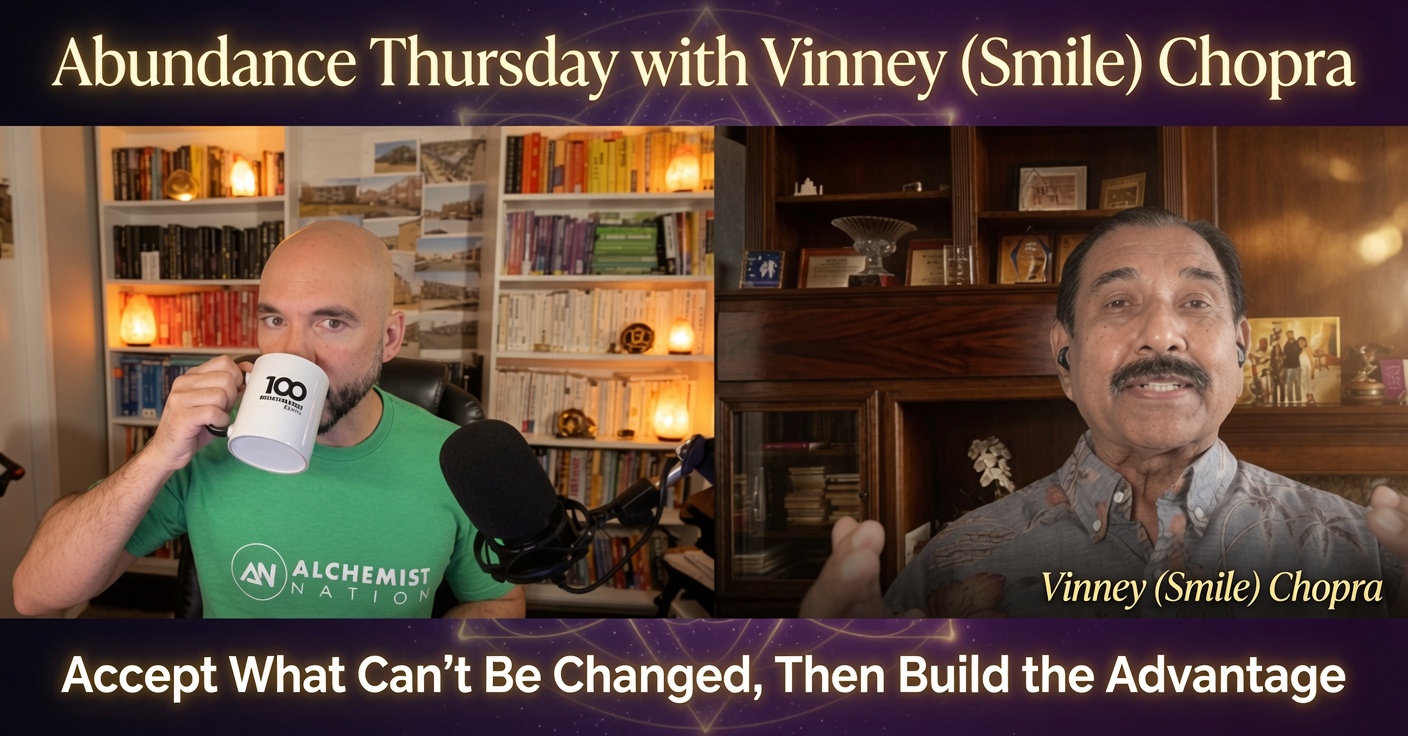
Accept What Can't Be Changed, Then Build the Advantage: Abundance Thursday with Vinney (Smile) Chopra
Most people meet a hard fact and freeze. The deal is what it is. The market is what it is. The building has the rooms it has. This week on Abundance Thursday, the conversation circled one idea that quietly separates people who build wealth in real estate from people who stay stuck: accept what cannot be changed, then create an advantage with it. Guest host Vinney (Smile) Chopra walked through real properties he owns to show what that looks like in practice, and the through line was simple. You do not argue with reality. You work with it until it works for you.
None of what follows is financial, legal, or tax advice. It is a recap of a conversation between two people who are passionate about real estate, shared for educational purposes only. Every property mentioned is described as a case study, not a promise of any result.
A hotel that refused to stay average
The clearest example came from a hotel in Columbus that Vinney and his partners bought for around eleven million dollars. The building started life as a large suites hotel, roughly 195 keys, with rooms far bigger than the market needed. He could not change the bones of the building overnight. What he could change was how the square footage was used.
So the plan became a full renovation, in the range of twenty five million dollars, reflagging the property to a new brand and opening as a true full service hotel. Two floors of oversized suites are being reworked into individual rooms, which pushes the count up toward 230 keys. That is roughly 35 additional rooms inside a building they already owned. The team also found the hotel carried about a thousand locker rooms, used mostly by office workers from the tower next door. Rather than treat that as wasted space, they cut the lockers roughly in half and are building meeting rooms in the freed up area, which turns dead square footage into another source of revenue. The property is targeted to open in December.
That is the principle in one move. Vinney could not change that the building existed the way it did. He accepted it, then asked the only question that matters: what is the best use of what I have been handed?
A high rate market is a tool, not a wall
The conversation turned to interest rates, which had shifted again the day before. Vinney shared a property in Knoxville where a variable rate pushed the monthly mortgage from about twenty eight thousand dollars up to forty five, then sixty five thousand. He did not pretend it was fine. He faced it, refinanced into a fixed rate, and was eventually able to exit. As he put it, whenever there is a big wall, "I always say there is a window somewhere." The job is to go find the window.
The host offered a reframe that does not get said often enough. Higher rates tend to push prices down, which can favor a disciplined buyer at the point of purchase. Today's rates are high by the standard of the last forty years, so anyone buying now is buying at prices shaped by that pressure, with a reasonable chance that rates ease over time. Nobody can promise where rates go next. The point is that the same condition most people treat as a closed door can be read as an opening, depending on which side of the deal you are on.
What truly cannot be changed: a story from 2020
The strongest test of the principle came from a hotel Vinney's group bought on December 31, 2019. Nobody knew what was coming. When the pandemic hit, occupancy fell from about 87.5 percent to roughly 25 percent, and for a couple of months the partners covered the mortgage out of their own pockets. That part could not be changed. The pandemic was not negotiable.
What could change was the response. Working with the certified company that managed the property, the team looked at the town around them, which had a heavy presence of hospitals and healthcare workers. They proposed turning the hotel into quarantine and housing space and signed block leases covering six month stretches, so revenue came in whether or not every room filled on a given night. The property stabilized, its value roughly doubled over time, and it was later sold. The wall was real. The window was found.
Most things called passive still involve work
A theme ran underneath the whole talk: there is work in real estate. There is work in hotels, in multifamily, in senior housing, even in the asset classes people assume run themselves, like storage. The host was candid that he and his wife, who is also his business partner, built their current operations so they could sell them over the next few years and make the transition from operating to passive income, still earning tax advantaged income through good people doing good work.
Vinney described the same arc from the other side. At his peak he ran two management companies with around 158 full time staff and payroll every two weeks. Today his hotels are run by professional, certified operators, and his role is to manage the managers. The people who back his deals have, in his words, grown more senior and want to stay passive while still earning steady cash flow. The lesson both men kept returning to is that the real skill is not doing every job yourself. It is learning to think like a banker rather than an operator, then finding a partner who is not stretched thin, who has real systems and the bandwidth to perform.
No experience and no capital are not dead ends
This is where the principle becomes useful for anyone earlier in the journey. You cannot instantly buy experience. Banks want to see it, sellers want to see it, and a newer person simply does not have it yet. That fact cannot be changed. The advantage you can create is partnership. Team up with someone who already has the track record, and the gap stops being a barrier.
The same logic applies to money. If you do not have the capital, the host's blunt advice was to stop being greedy about owning all of it and let other people put capital to work alongside you in a strong deal. Understanding the four tiers of capital makes it easier to see where your contribution fits and how to structure the partnership. You cannot change what you lack in this moment. You can create an advantage, often for other people at the same time.
How to build the mindset that finds windows
The two of them closed on how to actually cultivate this way of thinking, because it is a habit, not a personality trait. The first step is to refuse to give the problem too much room. Write the problem down on paper so it is out of your head. Keep your head free for ideas. Then ask the working question on repeat: how do I solve this, and how do I create an advantage here. Vinney framed it as controlling the controllables, and noted that when you stay stuck asking why, why, why, you only find more reasons to stay where you are.
That is the whole of it. Accepting what cannot be changed is not surrender, and it does not mean nothing can be improved. It means you stop spending energy fighting the fixed part of the situation so you can spend all of it on the part you can move.
Abundance Thursday runs most Thursdays at 12 p.m. EST and 9 a.m. PST. If this principle landed, sit with one situation you have been treating as a closed door and ask the better question. A good place to start is knowing your own tendencies, so take a few minutes with the real estate operator archetype quiz to see what kind of real estate operator you are and where partnership would create the most leverage for you.

Further Reading
Dead Equity: What Your Paid Off Property Is Really Costing You breaks down what equity sitting idle actually costs you and what the alternative looks like.
The ROE Audit: How to Know if Your Portfolio Is Quietly Underperforming gives you a way to measure return on equity across everything you hold.
What Quiet Wealth Actually Looks Like in Practice shows what life looks like once the work is optional and the income keeps coming.
Keep Going
The REAP call runs every Saturday at 10:00 AM ET, where these principles get applied to real deals and real operations. You can read the rest of the REAP series at AlchemistNation.com under "Fundamentals" If you want to reach me directly, go to callgualter.com.
VinnyChopra.com/freebook link the host requested on-air