Build the System First, Then Hire the Person
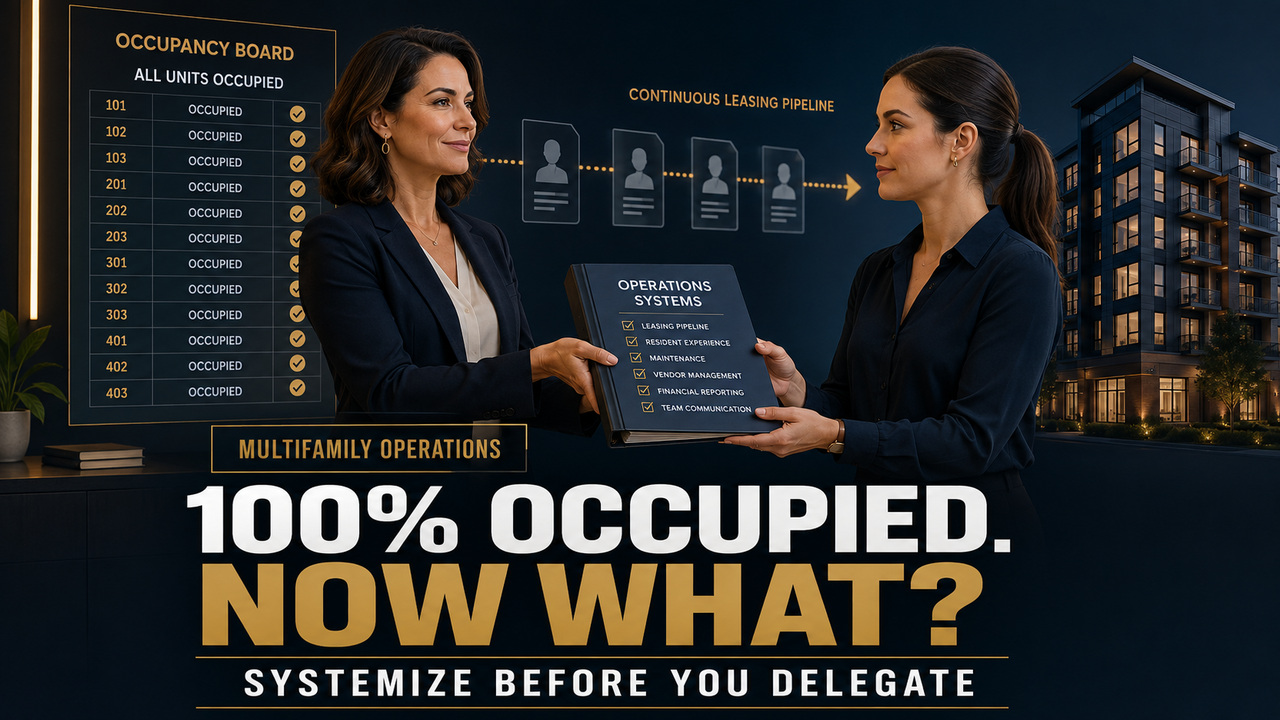
One of the property owners in our accountability group hit 100% occupancy on her multifamily units minutes before this week's call. She had come prepared to ask about lease-up strategy. By the time she unmuted, the challenge had solved itself.
What she raised instead was sharper: now that she is full, how does she hand this process off without watching it fall apart the moment she steps back?
The answer the room gave her was not what she expected.
The Default Move and Why It Tends to Backfire
Most landlords think delegation looks like this: you are overwhelmed, you find someone to handle the work, and the problem disappears from your plate. That is the assumption.
What actually happens is that bringing a person into a disorganized system does not fix the system. It scales the disorganization. Whatever confusion, gaps, or informal workarounds already exist in the operation get handed to someone who now has to navigate them without the context that made them work when only the owner was doing it.
One of the longer-tenured property operators in the room put it plainly: build the infrastructure first. Bring the person in second. Reversing that sequence is the single most common reason hires fail in smaller portfolios. The owner ends up managing the hire instead of the outcome, and three months later everyone wonders why the delegation did not take.
What Infrastructure Actually Means
"Infrastructure" sounds like a capital project. It is not. For most operators at the unit-management level, it comes down to being able to answer one question clearly: what does this work actually consist of?
If the honest answer is "I handle things as situations come up," that is the gap. Not in staffing. In definition. You cannot hand off a job you cannot describe.
Here is a practical method that does not require two weeks of manual writing. When you bring someone on, have them send a short note at the end of each day for the first two weeks. What did they handle. What did they accomplish. What questions came up.
Those questions become the FAQ. The FAQ becomes the SOP. You never had to write the procedure from scratch, because the person doing the work surfaced exactly what needed to be answered. The documentation builds itself out of the actual work rather than out of memory or assumption.
This also tells you something useful about the hire. Someone who sends clear, specific daily notes is paying attention. Someone who sends vague ones is not. You learn both things early, which is worth knowing.
The Trap Right After Full Occupancy
There is a second thing that came up alongside the delegation question, and it is worth naming because it tends to feel invisible until the damage is done.
A lot of operators stop marketing when they hit 100% occupancy. The reasoning feels logical: the units are full, so why spend time or money generating leads for units you do not have?
Vacancy is not a question of whether. It is a question of when. Leases end. Tenants give notice. Situations change. If marketing stops at full occupancy and restarts the moment a unit opens, the pipeline starts from zero each time. That is the expensive version of the problem, and it is entirely avoidable.
What one of the operators in the room described was running at least one form of outreach consistently, regardless of current occupancy. Not at high cost. Just consistently. The goal is not to fill units you do not have. The goal is to never have to rebuild a cold pipeline from scratch because the last one was shut off when things looked good.
Full occupancy is the right moment to systematize the marketing, not to stop it.
The Time Question Behind All of This
The delegation question and the occupancy question are both versions of the same underlying problem: how are you spending your time, and is that time going where it actually creates leverage?
A framework that came up in the room divides working time into three buckets. Production is doing the work: managing units, handling tenant issues, reviewing leases, following up on maintenance. Consumption is learning: reading, listening, researching. Promotion is being seen: lead generation, networking, building relationships, showing up where the next opportunity comes from.
Most operators in growth mode spend the largest share of their active time in production and consumption. The operators who scale consistently tend to spend the largest share in promotion, because that is where the next deal, the next tenant, and the next relationship actually enters the business. Production and consumption are both necessary. Neither one by itself generates the next opportunity.
If your systems are working the way they should, you get time back. That time should go toward promotion, not toward more production. The leverage lives in the ratio.
Run your own return on equity for each property you hold using the ROE Calculator to see what operational efficiency is actually worth in dollar terms. When systems are weak and an owner's time goes to plugging gaps manually, the return per dollar of equity held is usually lower than the number suggests on paper.
The Sequence Matters More Than the Speed
Before the next hire: write out what the role actually consists of, in plain terms. What does a strong week look like for this position? What are the two or three things this person should touch every day? If the answer is not clear, clarifying that is the first job, not the job posting.
Before the next vacancy shows up: make sure something is already running. One form of outreach, one channel, going consistently. It does not have to be large. It has to be on.
The operators who build durable portfolios are not always the ones who move fastest. They are usually the ones who sequence correctly.
The Alchemist Mastery accountability calls happen weekly. This is where operators at every stage bring their real challenges, not hypothetical ones, and the room works through them together.
If you are building a multifamily portfolio and want to think through problems in a room that has seen most of them before, this is where that happens.
Learn more at AlchemistNation.com.
*Educational purposes only. Not an offer or solicitation.*