Before You Close, Before You Build: The Research Discipline That Separates Operators from Gamblers
Most people treat the deal as the hard part. They spend months sourcing, negotiating, and structuring, then exhale when they reach the closing table. What they discover afterward, usually at real cost, is that the research that should have shaped every one of those decisions was never done.
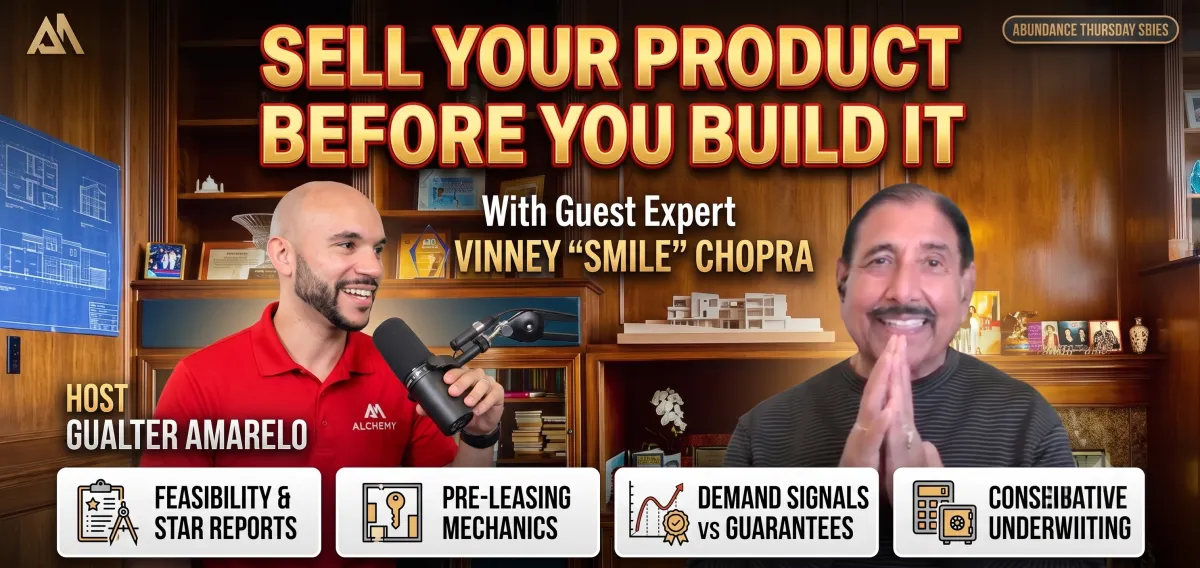
On a recent Abundance Thursday session, Vinney (Smile) Chopra walked through the due diligence process he follows before committing to any acquisition: senior living facilities, hotels, and any business opportunity. The pattern is consistent. Prove demand exists before you build, buy, or lease a single thing.
The Trap: Starting Without a Customer
The entrepreneurial instinct is to move. An idea surfaces, excitement builds, and the machine starts running before anyone has asked a single potential customer whether they want what is being created.
Vinney (Smile) Chopra frames the same problem this way: when you climb a mountain, do you look back to see who is following? Most builders and operators do not. They get deep into execution before they check whether the market actually needs what they are producing.
The consequence in real estate, hospitality, and senior living is severe. Construction cycles run two to four years. Loans are underwritten against projections. If the product is obsolete by delivery, or if demand was never there, the exposure is not a bad quarter. It is everything.
What Feasibility Studies Actually Cost
For operators who have not commissioned a professional market study, the numbers are more accessible than the reputation suggests. For senior living developments, Vinney (Smile) Chopra cited $5,000 to $7,500 for an 85-page report covering capture rate, competitive landscape, demographic demand, and market trajectory. His hospitality development partners commission studies in the $20,000 to $30,000 range for hotel projects before committing to a project of $20 million or more (his estimate based on what he has observed from development partners, not a figure he paid directly).
The calculus is straightforward. Spending $7,500 to verify whether a 94-unit senior living facility has sufficient local demand is not overhead. It is the single most efficient use of capital in the entire deal. Skipping it to save the fee is a decision that has buried far more than $7,500.
How Vinney (Smile) Chopra Pre-Leases Before the Building Exists
The principle extends past the feasibility study into operations. For one senior living development in Punta Gorda, forty-five residents moved in the first month the facility opened. That result did not come from an aggressive push at opening. It came from months of relationship-building with families while the building was still under construction.
The leasing agent had been in contact with interested families well before the doors opened. By the time the building was ready, demand had already been nurtured and converted. The physical product confirmed what the research had established: the need was real, the location was right, and the market was there.
This is not a technique unique to senior living. Video game publishers sell access to games that do not yet exist. Pre-orders collect commitments against products not yet in production. Multifamily landlords who understand operations begin marketing units before a purchase closes, using photos from the best existing units or from the seller's materials, so that the lease-up is already in motion the day the keys transfer.
The offer precedes the product.
Hotel Due Diligence: What the STAR Report Tells You
In hospitality, the research process has its own vocabulary. The STAR report is a standardized benchmarking tool that reveals occupancy rates and average daily rates for comparable properties in a given market. Vinney (Smile) Chopra reads this data against the history of any hotel he considers: why did occupancy decline, what economic factors drove it, and what is the realistic recovery thesis.
Location analysis runs across four demand drivers: proximity to hospitals, universities, corporate sectors, and tourism. A hotel with multiple demand sources has built-in resilience. One dependent on a single demand category carries concentration risk that no renovation can fix.
When a brand partner agrees to affiliate with a property they value, they sometimes offer key money: a cash contribution made in connection with the flag relationship. For operators who structure it correctly, that money can be directed back through the deal even during renovation, before the property has reopened and operations have resumed. The ability to access this depends entirely on identifying the right brand fit during due diligence, before the deal closes.
Signals Versus Guarantees
There is one distinction Vinney (Smile) Chopra made that is worth stating clearly. National retailers spend heavily on location research before opening new stores. Their presence in a neighborhood is a signal that underlying demand analysis has been done. It is not a guarantee that an adjacent real estate project will perform.
Treat the presence of major retail as a starting point for your own research, not as a conclusion. The retailer's data tells you the area was worth studying. It does not tell you that your specific asset class, at your specific price point, will perform.
From there, the next layer is direct contact. Talk to local brokers and property management companies. A property manager who operates in a specific submarket will tell you what rents are actually achievable, how long units sit vacant, what the renovation economics look like, and what the competition is actually doing rather than what it is advertising.
The Role of Conservative Underwriting
Once a deal closes, the operator is on the title. The exposure is real, and the variables that were controllable during due diligence are now fixed. What remains are the variables that cannot be controlled: insurance rates, property taxes, interest rate movements, and local economic shifts.
This is why underwriting assumptions must be conservative from the start. Projections built on optimistic due diligence become liabilities under operating stress. The feasibility study and market research are not boxes to check to satisfy a lender. They are the foundation of every projection that follows.
*Nothing in this post constitutes financial, legal, or tax advice. Real estate involves risk, including the possible loss of capital.*
What to Do Before the Next Deal
The throughline from Vinney (Smile) Chopra's approach is straightforward. Research is not a luxury reserved for large operators. It is the discipline that separates those who make repeatable decisions from those who get lucky occasionally.
Before the next deal, before the next business launch, before the next product build: commission or conduct a market study appropriate to the scale of the commitment. Talk to local operators, property management companies, and brokers. Use demand signals such as retail anchor presence and population trends as starting points for deeper inquiry. Confirm there is a real customer before capital is committed.
For a deeper look at how capital and due diligence connect across the stages of a portfolio, the four tiers of capital framework is the right starting point. If you are working to shift from a worker mindset to an operator mindset, the banker mindset post covers the underlying philosophy. Before any new acquisition, run the return on equity audit on what you already own.
To find out which operator archetype best matches where you are right now, take the operator archetype quiz.
Further Reading
Abundance Thursdays is part of the AlchemistNation REAP series. To speak with our team directly, visit callgualter.com.
*Educational purposes only. Not an offer or solicitation.*