The Flywheel Principle: How to Build a Business That Improves Itself
There is a trap that catches capable people, and almost nobody sees it coming, because it wears the mask of a strength. The better you get at running your operation, the more that operation quietly reorganizes itself around you. Every decision routes through you. Every fire gets put out by you. Every improvement waits for you to have a free afternoon. You become the most skilled person in the building and, at the same time, the hard ceiling that nothing can grow past. Skill is not the finish line. Left unexamined, it is the thing that keeps you doing forever.
I ran into this wall the way most operators do, which is by being good enough to survive without solving it for a long time. The lesson that finally moved me past it was not a new tool and it was not working harder. It was a different kind of system entirely: one that improves itself. This is the flywheel principle, and once you understand it, you stop asking how do I do more and start asking how do I build the thing that gets better without me.
Building a business that runs on systems instead of on your presence is the same move a serious investor makes when they go from active to passive. The machinery changes, but the principle underneath is identical. You stop being the engine and start being the person who designs the engine.
The highest form of leverage is not a tool that works for you. It is a system that improves itself while you supervise instead of operate.
Stop Inventing. Start Wiring.
The first thing I got wrong for years was believing that the next level required something new. A new tool, a new hire, a new tactic, a new platform. So I kept building outward, adding pieces, and every new piece added its own maintenance and its own dependency on me. I was accumulating parts and calling it progress.
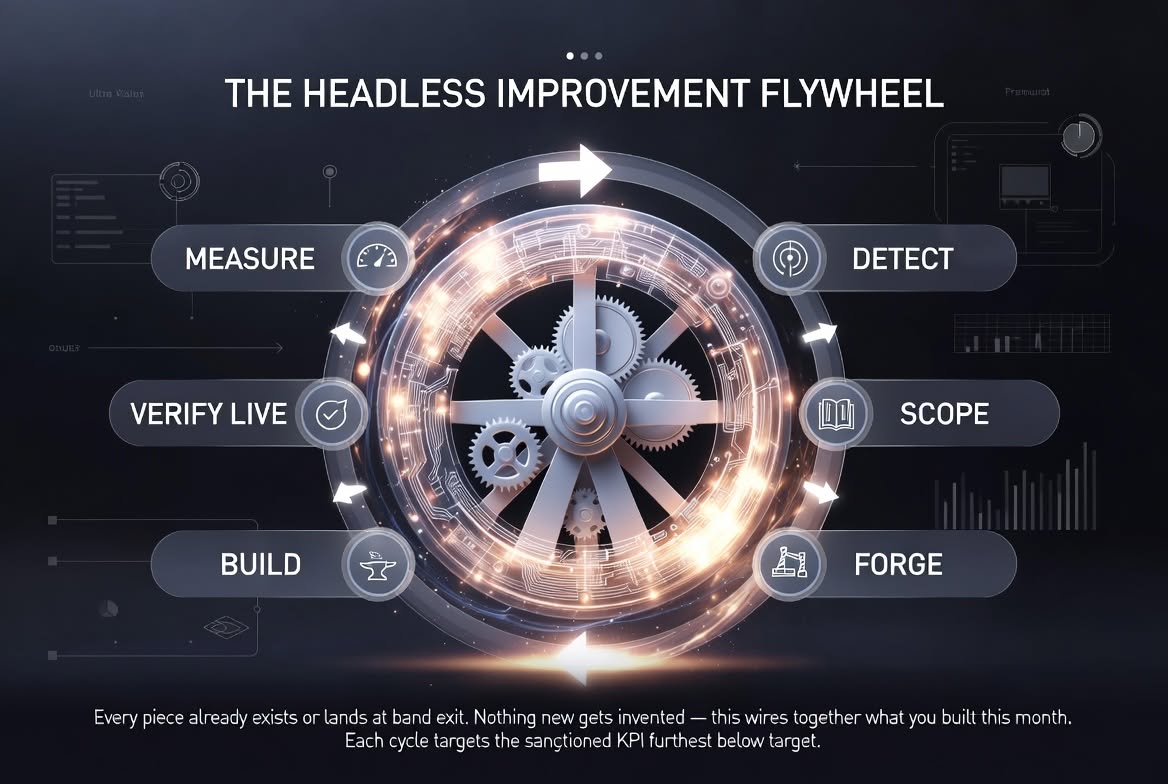
The breakthrough was almost embarrassing in its simplicity. I already had everything I needed. The tools existed. The processes existed. The data existed. What did not exist was a loop that connected them and pointed them at a target. Nothing new had to be invented. The work was wiring together what I had already built and giving it one job: find the weakest number in the business and strengthen it, then do it again.
That is the whole idea of a flywheel. It is not a single push that goes further. It is a loop that keeps its own momentum, where each turn feeds the next. The parts do not change much from cycle to cycle. The connection between them is what compounds.
The Machine Finds Its Own Weakest Point
Here is the discipline most people skip, and it is the difference between motion and progress. A good self-improving system does not work on whatever is interesting this week. It works on the one metric that is furthest below where it should be.
That sounds obvious until you watch how humans actually behave. We gravitate to the problem we enjoy solving, or the one that is most visible, or the one that made us look bad in the last meeting. The true bottleneck is often boring, and it sits quietly costing us money while we polish something that was already working. A system built on the flywheel principle does not have an ego and does not have a favorite. It measures honestly, detects the largest real gap, and scopes the smallest change that closes it.
Measure your real numbers. Detect the biggest gap between where you are and where you said you would be. Scope the smallest honest fix. Build it. Then verify it against reality, not against your hopes. That loop, run with discipline, will beat a genius working on the wrong problem every single time.
Build the Governor Before You Build the Engine
This is the part I want you to remember if you remember nothing else, because it is where most automation goes wrong and where a lot of trust gets destroyed. Before you give any system power, you have to build the part that knows what it is not allowed to do.
An engine with no governor does not just run fast. It runs fast in the wrong direction, confidently, at scale. If you tell a system to increase one number and give it no other instruction, it will happily wreck three other numbers to get there. Chase sign-ups and it will lower quality until the sign-ups mean nothing. Chase speed and it will cut the corners that were protecting you. The measure becomes the target, and the moment a measure becomes the only target, it stops being a good measure.
The fix is to pair every goal with a guardrail. For every number you are trying to move up, you name a number that is not allowed to move down. You define the decisions the system is never permitted to make on its own, and you have it park those for a human. A system you cannot trust to stop, to ask, and to hold a line is not leverage. It is a liability with good marketing. Build the brakes and the boundaries first. Build the horsepower second.
This is the same instinct that separates a real capital allocator from a gambler. The move from operator to banker is not about doing less. It is about building rules that protect the downside so relentlessly that you can finally afford to stop watching every move. You can read more about that shift in the banker mindset, and it maps directly onto how you should think about any system you turn loose in your business.
Earn Trust Before You Hand Over the Keys
When I finally had the flywheel built, I did not switch it on and walk away. I ran it in what I think of as a supervised mode. It was allowed to look at everything and propose what it would do, but it was not allowed to actually do anything. Every week it handed me a report: here is the weakest number, here is exactly what I would change, and here is what I refused to touch because it needed your judgment.
I watched it in that powerless state for weeks. Not because I doubted the mechanics, but because trust is earned by watching judgment under real conditions, not by reading a spec sheet. I was grading its decisions while the stakes were zero. That is the same reason you do not hand a new hire the checkbook on day one, and the same reason you do not wire capital into a deal with someone whose track record you have only heard about. You let them show you their thinking first, on small things, where being wrong costs nothing.
Delegation without that proving period is not trust. It is hope wearing a suit. Whether you are handing authority to a person, a partner, or a system, the sequence is the same. Let it prove its judgment while it is powerless, then widen its authority one notch at a time as it earns each one. Using new tools, including AI, as genuine leverage instead of a gimmick works exactly this way, which I get into more in the power of outsourcing with AI.
Actionable Takeaways
Look honestly for the place your business depends on you personally, and treat that dependency as the ceiling it actually is rather than the strength it feels like.
Before you build anything new, ask what you already own that is sitting disconnected. The next level is usually wiring, not inventing.
Point every improvement cycle at the single number that is furthest below target, not the problem that is most fun or most visible.
For every goal you set, name the counter number that is not allowed to get worse while you chase it. A goal without a guardrail is a trap.
Never give a person or a system real authority until you have watched its judgment while the stakes were low. Trust is a track record, not a leap.
Further Reading
The Banker Mindset — why the safest investors stop operating and start allocating, and how that same shift applies to the systems you build.
From Active to Passive — what the transition away from doing everything yourself actually looks like in practice.
The Power of Outsourcing with AI — using AI as real leverage in your operation instead of a novelty.
Ready to Go Deeper?
The operators who build real wealth are rarely the ones grinding hardest. They are the ones who built the machine and then had the discipline to supervise it instead of becoming it. Inside Alchemist Nation, this is the kind of thinking we work through together every week, taking principles like the flywheel and turning them into systems you can actually run in your own business and portfolio. If this lesson landed, come sit in on a live call and bring the one place your operation still depends entirely on you. That dependency is your next flywheel.